

Lulu yelped. One short sound, more surprise than pain, and then she tucked that paw under her chest and looked at me as though I had personally let her down. I had cut maybe a hundred nails on that dog with clippers and never once drawn blood. But something about that one nail was different, and she remembered it for weeks afterward. That was in July. Within a week I had ordered a Casfuy Dog Nail Grinder, partly out of guilt and partly because the clicking on my hardwood floor had worked its way into my last nerve.
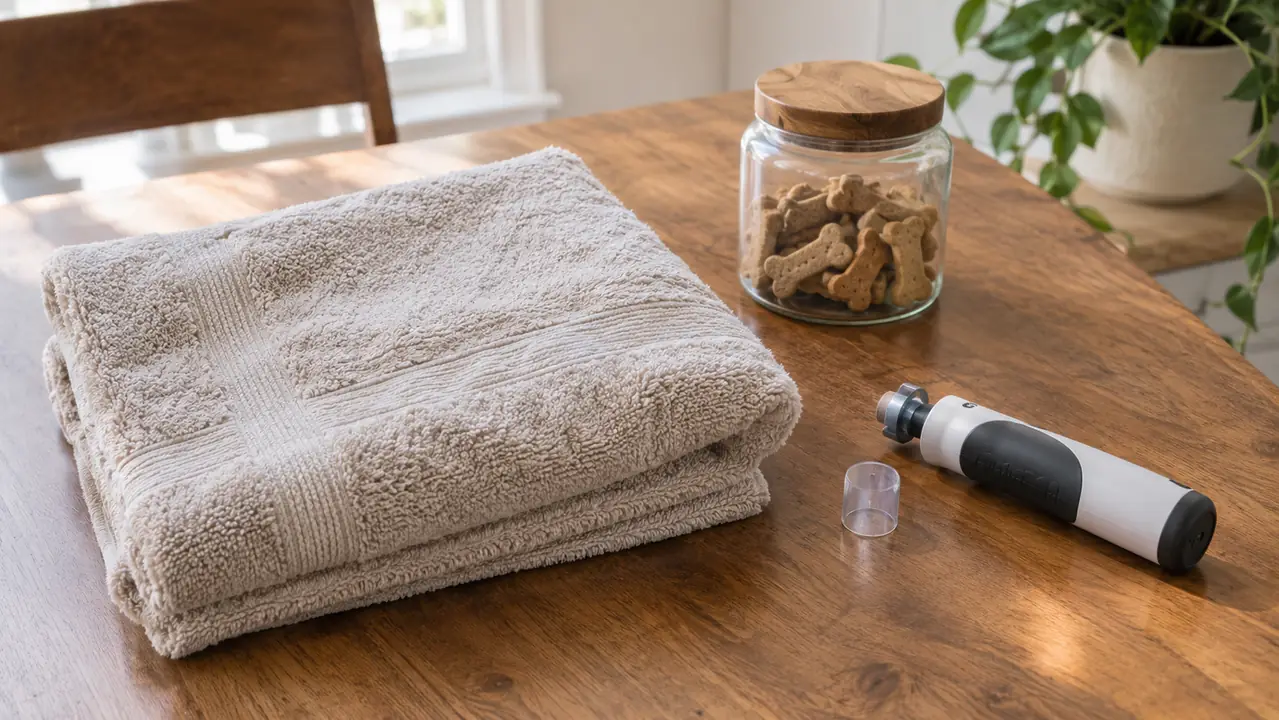
I am 63, I live alone in a one-story brick ranch outside Roanoke, and I keep a tidy house. Some of that tidiness is because Lulu is a seven pound Maltese with a long white coat and she is on my couch every single evening. Some of it is because I am particular. Either way, when I tell you I have done nails on my kitchen table, on a folded towel, every two weeks for four months, I mean it exactly literally. There is a towel. There is a treat jar. The whole thing has a routine now.
The Quick Verdict
Quiet enough that a fussy seven pound dog stays on the towel, and slow enough that a mistake comes off in slivers instead of slices. It will not make your dog enjoy nail day. It makes nail day survivable.
Amazon Check Today's Price →The quiet motor is the whole reason a nervous dog stays put
Two speeds, three grinding ports sized for small through large nails, and a cordless body that weighs under ten ounces. If clippers have turned into a wrestling match in your house, this is the version of nail day a small dog can sit through.
Amazon Check Today's Price on Amazon →How I've Used It, Week by Week
The grinder arrived in July in a box about the size of my hand. It measures 6.89 by 2.95 by 1.38 inches and weighs 9.9 ounces, and that number matters more than it sounds when you are holding it steady against a moving paw for ten minutes. Anything heavier and your wrist begins to drift, and a drifting grinder is precisely what makes a dog pull her foot away. Mine lives in the kitchen drawer by the dish towels now, next to the slicker brush, and it takes up less room than a pair of scissors.
The Casfuy is cordless with a built-in rechargeable battery, and the listing says up to two hours of runtime after a three hour charge. I charge it, use it four or five times, and charge it again. Four months in, it has never once gone flat on me in the middle of a paw, and I have stopped thinking about the battery at all, which is the highest compliment I can pay a cordless tool. The first charge out of the box took the full three hours and I sat there like a nervous aunt waiting on a pie to brown. Now I plug it in on a Friday evening and it is ready when I want it on a Saturday morning.
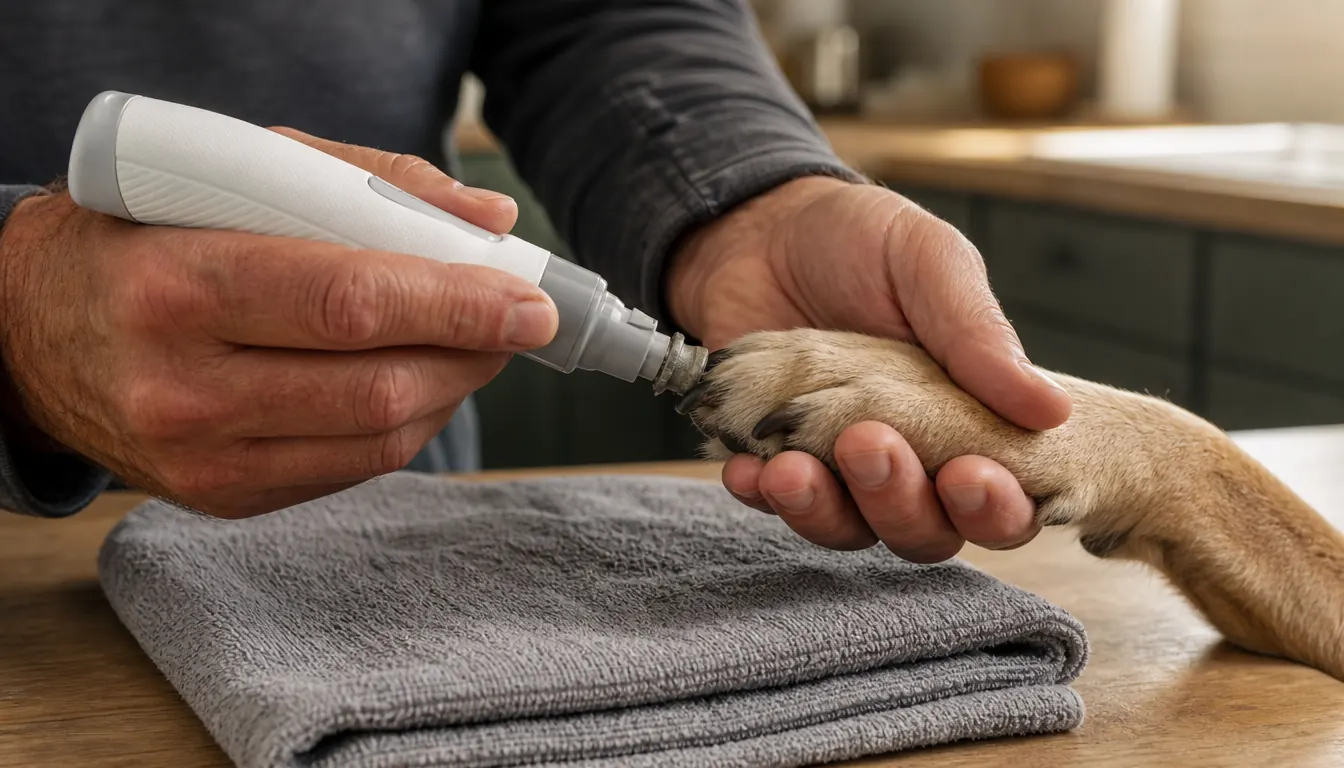
My routine has not changed since week two. Towel on the table. Lulu up. One treat before we start, because she will not get up there for free. I hold each paw the way a groomer showed me years ago, thumb across the top of the foot and fingers underneath, so the leg is supported instead of dangling. Then the nail goes into the smallest of the three ports and I take a little off the tip. Ten seconds, look, ten more seconds. She gets a treat between paws whether she was good or merely tolerable, because I am rewarding her for holding still and not for her opinion of the process.
I count in my head while the nail is in the port, and that is not a figure of speech. One Mississippi, two Mississippi, up to ten, then the grinder comes off the nail. I learned that the hard way in the second week, when I tried to watch the nail instead of counting and let it run closer to fifteen seconds. She pulled away and licked at the foot for a minute afterward, and I do not know whether it was heat or nerves, but I did not repeat it. Counting gave me something to do with my attention that was not worrying.
What Nobody Tells You About Nail Grinders
Nobody tells you that grinding is slow. I wish someone had said that to me in July instead of leaving me with the impression that this was a five minute job. You are not cutting a nail off, you are sanding it down in small passes, and if you try to hurry you will press harder, and pressing harder creates heat, and heat is the one thing a dog will not forgive you for. Ten seconds on, then check, then ten seconds again. All four paws takes me about ten minutes now, and that is with a cooperative dog who is being paid in chicken.
Nobody tells you that you end up touching the paw far more than the nail. Half of my progress with Lulu had nothing to do with the motor at all. It was that the grinder forced me to hold each paw for a while, calmly, with nothing painful happening at the end of it, and then set it down and hand over a treat. That is a completely different experience for her than the clippers were, which was a cold squeeze, a sharp noise, and then it was over. She learned that a held paw did not lead anywhere bad. That took about three weeks and I would call it the real work.
Nobody tells you about the dust. It is fine, it is pale, and it settles on everything within a foot of the table. I keep a paper towel under the paw now and I wipe the table down afterward as a matter of habit. Some people wear a mask for this and I would not argue with them. It is nail, not flour, and it does not belong in your lungs or in your dog's. I keep a second folded towel on the chair beside me for the wipe-down, because by the third paw the first one is gritty and there is no sense pretending otherwise.
Holding a paw stopped meaning something bad was about to happen. That was the change, and it had almost nothing to do with the motor.
The First Few Weeks Were Not Cute
I want to be honest about the beginning, because the beginning is where people quit and then write a review saying the tool does not work. The first night I did two nails. Not two paws. Two nails. She pulled her foot back, I let her have it, we had a treat, and we stopped for the night. The second night, three. There were evenings she managed one nail and I called it there. If you are the sort of person who needs a task finished once you have started it, this will try your patience, because the correct move is almost always to stop early.
It took about three weeks to get through all four paws in one sitting without a negotiation. Now the whole thing is ten minutes, front left, front right, back left, back right, treat after each. If she has had enough, she takes her paw back and I let her keep it. There is no point in a contest of wills with a seven pound dog at your kitchen table, because you will win and she will remember that you did.
One thing I got wrong early. I was holding her too tightly. I had it fixed in my head that she would bolt, so my grip was firm, and she wiggled, and the firmer I held the more she wiggled. Loosening my hand is what fixed it. That and the treats, which are a bribe, and I am not above bribery in my own kitchen.
Another thing I got wrong was the room. I started out doing this on the kitchen table in the evening, with the television going in the next room, because that is when I had the time. She was worse than she needed to be. I moved nail day to Saturday morning after her breakfast, with the house quiet and the window over the sink letting in light, and the difference was not subtle. Same towel, same treats, same dog. She simply does better in the morning, and it took me a month to notice that I was the one who had picked the harder hour.
The Two Speeds and What the Ports Are For
Two speeds sounds like a line on a box until you own one. The motor runs between 7,000 and 8,000 RPM depending on which of the two settings you pick. Low is for small nails, nervous dogs, and the last few passes when you are shaping a tip rather than taking off length. High is for thick nails on larger dogs and for the first passes on a nail that has gotten long. I have used high exactly twice, both times on the dewclaws, which grow longer than the rest because nothing wears them down.
The three grinding ports are sized for small, medium and large nails. You are not swapping parts, you are choosing which opening to put the nail into. The small opening holds a small nail steadier, which is what you want when the dog is shifting her weight and you are trying very hard not to catch the quick. Lulu is seven pounds, so the small port is the only one she will ever use. The other two are there because the Casfuy is built to cover a much bigger dog than mine.
The body is ABS plastic, which makes it light and means it does not feel like a piece of medical equipment in your hand. That suits me. I am holding it for ten minutes, not dropping it off a ladder. It is quiet, but I want to be careful with that word, because quiet is relative. It is not silent. Nothing that spins is silent. It is quiet enough that Lulu, who will leave the room if I so much as open the drawer the clippers used to live in, stayed up on the towel. I tested that once out of pure curiosity, setting the clippers on the counter and the grinder on the towel, and she walked away from the counter and climbed up to the towel. I have not needed a second experiment.
What It Doesn't Fix
It does not make your dog enjoy nail day. Lulu tolerates it. She climbs onto that towel because she knows chicken is involved, not because she has developed an appreciation for grooming. If you are buying this hoping for a dog that rolls onto her back and offers a paw, that dog exists on the internet and probably not in your house.
It does not remove the need to know where the quick is. On a pale nail you can see the pink and it is straightforward. On a dark nail you cannot see anything, and the rule I use is to take a little at a time and look at the end of the nail after every pass. When you see a small pale ring with a darker dot in the middle, you are close, so stop. Grinding is more forgiving than clipping because you are removing slivers rather than slicing, but forgiving is not the same as foolproof. If a nail is cracked, or grown down into the pad, or looks infected, that is a vet visit and not a kitchen table project.
It does not do anything for the rest of the grooming either. Nails are one item on a list. The mats behind Lulu's ears are the slicker brush's problem, the yellow on her legs is the whitening shampoo's problem, and the crust under her eyes is the eye wipes' problem. I would not want anyone buying this thinking it solves the whole dog, because it does not and nothing does.
And it does not replace my groomer. Lulu still goes every eight to ten weeks for a full cut. This just means that in between those visits her nails are not clicking across my floor like tiny tap shoes.
What I Liked
- Quiet enough that a fussy small dog will stay on the towel instead of leaving the room
- Two speeds and three ports let the same tool handle a seven pound dog and a ninety pound dog
- Cordless, with a built-in rechargeable battery and up to two hours of runtime on a three hour charge
- Light enough at 9.9 ounces to hold steady through a full ten minute session
- Takes nails off in slivers rather than slices, so a mistake is smaller than it is with clippers
Where It Falls Short
- Slow. Ten minutes for four paws now, and much slower than that for the first few weeks
- Fine pale nail dust settles on the table and has to be wiped up
- The high speed is more than a small dog needs, so one of the two settings goes unused
- The battery is built in, so there is nothing to swap in if you forget to charge it
- It does not make a dog who hates having her paws handled stop hating it, it only makes the handling survivable
Who This Is For
This is for the owner of a small dog who has been putting nails off because the clippers produce a yelp, a struggle, or a small bleed that leaves everybody feeling terrible. It is for someone who can be patient for three weeks while a dog decides the towel is not a trap. It is for someone who grooms at home between professional visits and just wants the clicking to stop.
It is also genuinely good for a dog who is frightened of the clippers specifically, rather than of being handled in general. The sound is different, the sensation is different, and there is no cold metal squeezing the toe. If the clippers themselves are the only thing standing between you and regular nail trims, this is worth trying before you give up and pay someone else.
Who Should Skip It
Skip it if you want nails done in two minutes, because this is not that. Skip it if your dog will not let you hold a paw at all and you have no interest in spending three weeks changing that, because the tool cannot do the work the handling does. Skip it if the nails are already overgrown into the pad, split, or look angry around the edges, since that is a conversation for your vet.
And skip it if you want something you never have to think about charging. The runtime is real and mine has never quit mid-paw, but a tool with a battery is a tool that can be flat when you need it. I plug mine in the night before nail day now, which is a small habit and a worthwhile one.
What I would tell a friend: this did not turn nail day into a nice time. It turned it into a boring ten minutes on a towel with a treat jar, and boring is what a nervous little dog can actually live with. That was the whole goal, and it worked.
Four months in, the clicking on my hardwood floor is gone
Two weeks at a time, ten minutes on the kitchen table, one treat between each paw. The grinder did not make Lulu love it. It made it possible, which is the part I actually needed.
Amazon Check Today's Price on Amazon →