
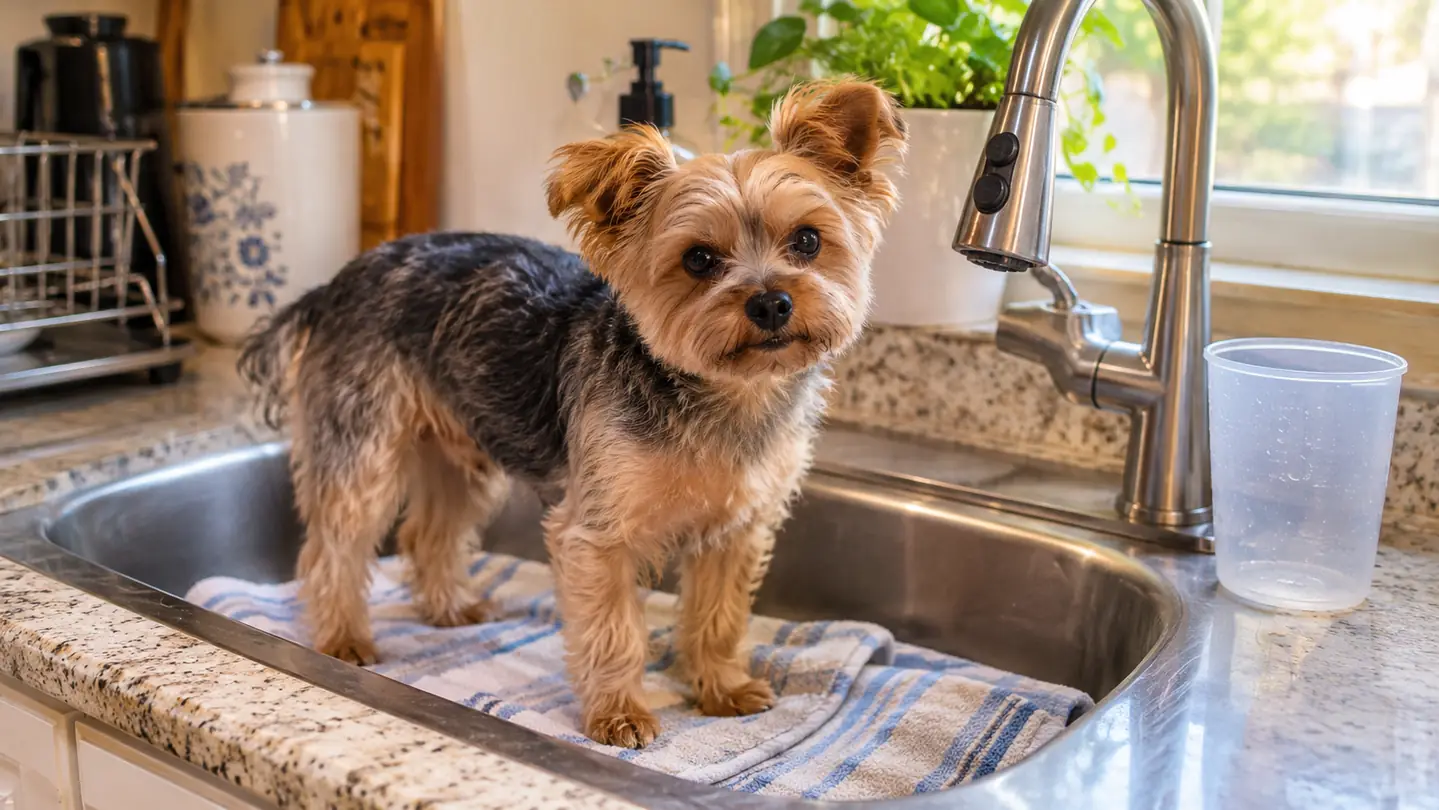
Lulu is a seven-year-old Maltese, about seven pounds, and for the first few years I bathed her in the tub like a normal person. I would kneel on the tile, lean over the edge, and try to hold a wet, squirming dog with one hand while feeling around for the shampoo with the other. My back ached for two days afterward. The kitchen sink is a better room for this job, and it took me an embarrassing amount of time to figure that out. A small dog fits in a sink. The counter comes up to my waist. The sprayer reaches places a plastic cup never will.
What I had to learn the slow way was the shampoo. A whitening shampoo is not the same as the everyday bottle from the grocery store shelf, and TropiClean Whitening shampoo is a fair example of the difference. It has one job, which is to brighten a white coat and knock down the yellow that builds up on a dog's legs and muzzle, and it does that job only when you use it a certain way. Too much product, or a lazy rinse, and you get a coat that looks dull and feels like straw. So here is the whole routine, the way it happens in my kitchen in Roanoke, with the bottle of TropiClean Whitening shampoo I bought back in March and am now partway through a second bottle of.
The bottle I keep a spare of so I never run out mid-bath
TropiClean Whitening shampoo, 20 oz, awapuhi and coconut scent. It is the shampoo in every step below, and the only one that has touched Lulu's coat since March.
Amazon Check Today's Price on Amazon →The order matters more than the timing. Setup, brush, dilute, rinse twice, dry, then the face. Here is how each one actually goes.
Step 1: Get Everything Into the Sink Before You Pick Up the Dog
The single biggest improvement to bath night was putting everything within arm's reach before Lulu comes into the kitchen. I set a folded towel on the counter to the right of the sink, a second towel for drying, the sprayer pulled out and tested so I already know the temperature, a plastic cup for diluting, and the shampoo itself. If your sink is deep or slippery, a rubber mat on the bottom helps a seven-pound dog feel steady. The rule I never break is this: I do not go looking for anything once there is a wet dog in the sink.
Water temperature is the other thing worth settling before you start. I run it warm on the inside of my wrist and stop there. Hot water is rough on a coat, and a dog cannot tell you it is too warm, so erring cool is safer. For a small dog I also put two or three inches of water in the sink and let it stand while I walk over to get her. Lulu plants her feet and stops fighting once she feels water under her, which is not what I expected the first time I tried it.
One more piece of setup: lay a third towel flat on the floor by the sink. Water goes everywhere with a small dog, because a small dog shakes off between rinses and each shake throws a surprising amount of water across the counter and down the cabinets. The floor towel takes ten seconds to put down and saves five minutes of mopping afterward.
Step 2: Brush the Coat Out Before Any Water Touches It
Water sets a mat. That is the whole reason this step comes first. If I wet Lulu with a tangle behind her ear, the tangle tightens into something I cannot get out with a brush, and it becomes the groomer's problem eight weeks later. So she goes on the folded towel on the kitchen table first, dry, and I work the slicker brush through her in small sections. The brush I use is a Coastal Pet Li'l Pals slicker, the small one, that I bought last fall after my groomer showed me the mats behind Lulu's ears.
There are four places I check every time, and they are the same four places mats always form: behind the ears, the armpits, the backs of the legs, and where the collar sits. I part the coat with my fingers, brush with the lie of the hair rather than against it, and go slowly at the armpits because the skin there is thin. Five to ten minutes is plenty. If I find a tight mat, I work at it with my fingers first, and if it does not come apart I leave it alone. A slicker brush loosens tangles. It does not cut a mat out, and pulling at one hurts.
The brushing is not really a bath-day job. I do it most evenings while the television is on, on the same towel on the same table, and by the time a bath comes around there is nothing left to fight with. That habit has done more for Lulu's coat than any product I have bought. If you only brush on bath day, you will spend the first ten minutes of every bath undoing a week of neglect.
Step 3: Dilute the Shampoo Before It Touches the Dog
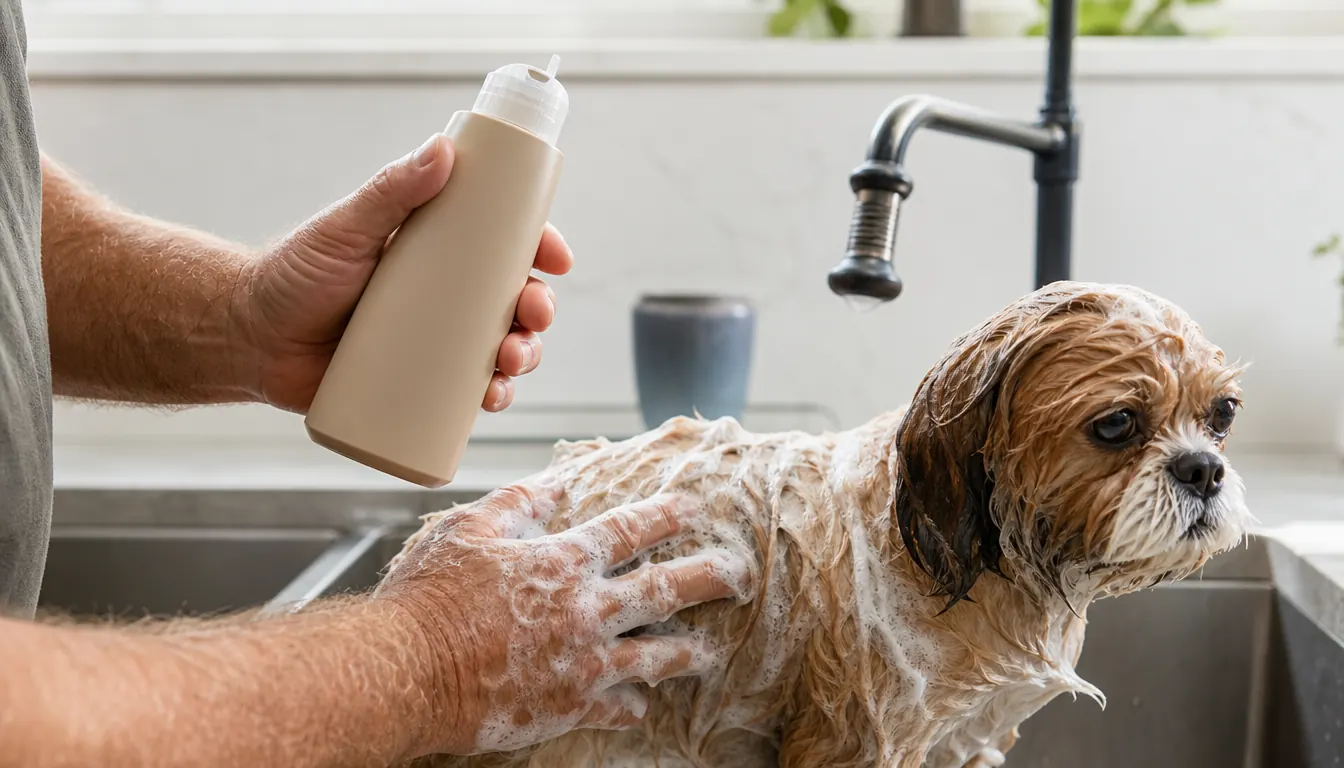
Here is the part most people skip. I do not squirt shampoo onto the dog. I put a small squeeze, about a teaspoon, into a plastic cup of warm water from the tap and swirl it until it goes cloudy, then pour it along her back and work it in with my hands. TropiClean is a liquid, pH balanced, and free of parabens and dye, and it lathers easily, so a very small amount covers a seven-pound dog from shoulders to tail. Diluting it first means it goes into the coat evenly instead of sitting in one thick patch between her shoulder blades.
The label mentions five times the cleaning power, which is not something I can measure in my kitchen. What I can tell you is that one 20 oz bottle of TropiClean has carried me from March through a bath every two to three weeks, and I am only partway into the second bottle. The coconut and awapuhi scent smells like a nice hotel, and it stays in the coat for days. Vitamin E is in the formula for conditioning, which I assume is the reason her coat does not feel stripped afterward the way it did with the oatmeal shampoo I used before this one.
Keep it off the face. I wash Lulu's head with a washcloth and plain warm water, working from the top of her head forward and staying well clear of her eyes and ears. Whitening shampoo near the eyes is a bad idea and it is not necessary, because the face is where the wipes do the real work anyway. If you do get shampoo somewhere it should not be, rinse it out with clean water right away and do not rub at it.
A whitening shampoo rarely fails because the product is wrong. It fails because it never got rinsed out of the armpits.
Step 4: Rinse Twice, and Aim the Sprayer Where You Do Not Think To
Two rinses, always. The first gets the bulk of the suds off. Then I go back with the sprayer and hit the places I know I missed the first time: the armpits, behind the ears, the belly, between the back legs, and under the chin. Those are the spots where shampoo sits against the skin, and a coat that dries stiff and flaky is almost always a rinsing problem rather than a shampoo problem.
The second rinse is where I slow down and use my hands as much as the sprayer. I run my fingers through the coat and feel for slip. A clean, rinsed coat has a faint squeak to it under your fingers. If it still feels slick or soapy, keep going. I probably use twice as much water rinsing as I do washing, and my water bill has not noticed.
Lulu hates having her paws touched, so the paws are last and they are quick. I rinse each one, get between the pads with my fingers, and move on. If your dog is more tolerant, do them earlier. The point is only that the paws are the hardest part with a fussy dog, and doing them last means the rest of the bath is already behind you when she starts to object.
Step 5: Dry Her, Then Do the Face While She Is Still Calm
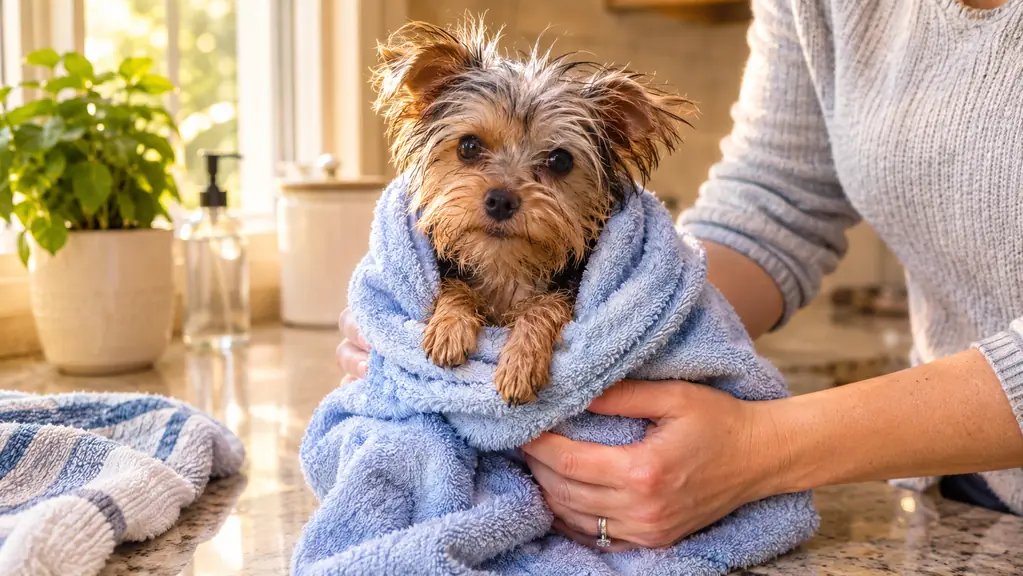
I take Lulu out and set her on the folded towel on the counter, then press the towel against her rather than rubbing. Rubbing tangles a long coat, and I have spent enough evenings undoing that to know better. Fresh towel, press, hold for a minute, and she stops shaking. Then I keep her in the warm kitchen until she is properly dry instead of letting her tear off damp into a cool room. In winter I will go through two towels and skip the dryer entirely, and if you do use one, keep it on the low, cool setting and keep it moving.
The face is the last step and it is the one that pays off between baths. I use the Earth Rated eye wipes, the unscented extra-large ones, one wipe a day. I sweep under each eye from the inside corner outward, gently, and I do not scrub at the stain itself. Done every morning, it keeps the damp gunk and crust from building up, and Lulu's staining stayed lighter because of that. I will be straight with you: it has not erased the old staining under her eyes. That faded slowly as the groomer trimmed the stained hair out over a few visits.
Do not use whitening shampoo on the face hoping it will fix tear stains. It will not, and it is not meant to. It brightens the coat on the body. Tear staining is its own separate thing, and red, swollen or itchy eyes are a question for your vet, not a grooming question. I say that as someone who spent a year buying products before I finally made the appointment.
What Else Helps
The bath is the visible part, but the things that make the house feel clean happen between baths. Nails first. Lulu's clicking on the hardwood was driving me up the wall. I use a Casfuy two-speed grinder on the low setting, with the small port for small nails, and I do it every two weeks on the kitchen table. After she yelped once with clippers, I switched and never went back. For the first few weeks we did two or three nails a night with a treat between paws. Now all four paws take about ten minutes, and the clicking is gone.
Teeth second. I brush Lulu's teeth most nights after our supper, sitting on the kitchen floor with her in my lap, about a minute with the Vet's Best kit and the banana toothpaste. She licks at the paste like it is a treat now, though it took two weeks to get her there. Her breath is noticeably better and my vet commented on her teeth at her last checkup. It does not replace a professional cleaning and it does not treat gum disease.
And a word on frequency. Lulu goes to the groomer every eight to ten weeks for a full cut, and I bathe her in the sink every two to three weeks in between. More often than that and her coat starts to feel dry. Between baths, a damp washcloth on the legs and belly after a muddy walk handles most of it. That plus the sink bath is enough to keep her smelling clean on the couch, which is really what all of this is about.
Start with the shampoo, then build the rest of the routine around it
The 20 oz bottle of TropiClean goes a long way at a bath every two to three weeks. It is the same bottle in every step above.
Amazon Check Today's Price on Amazon →