
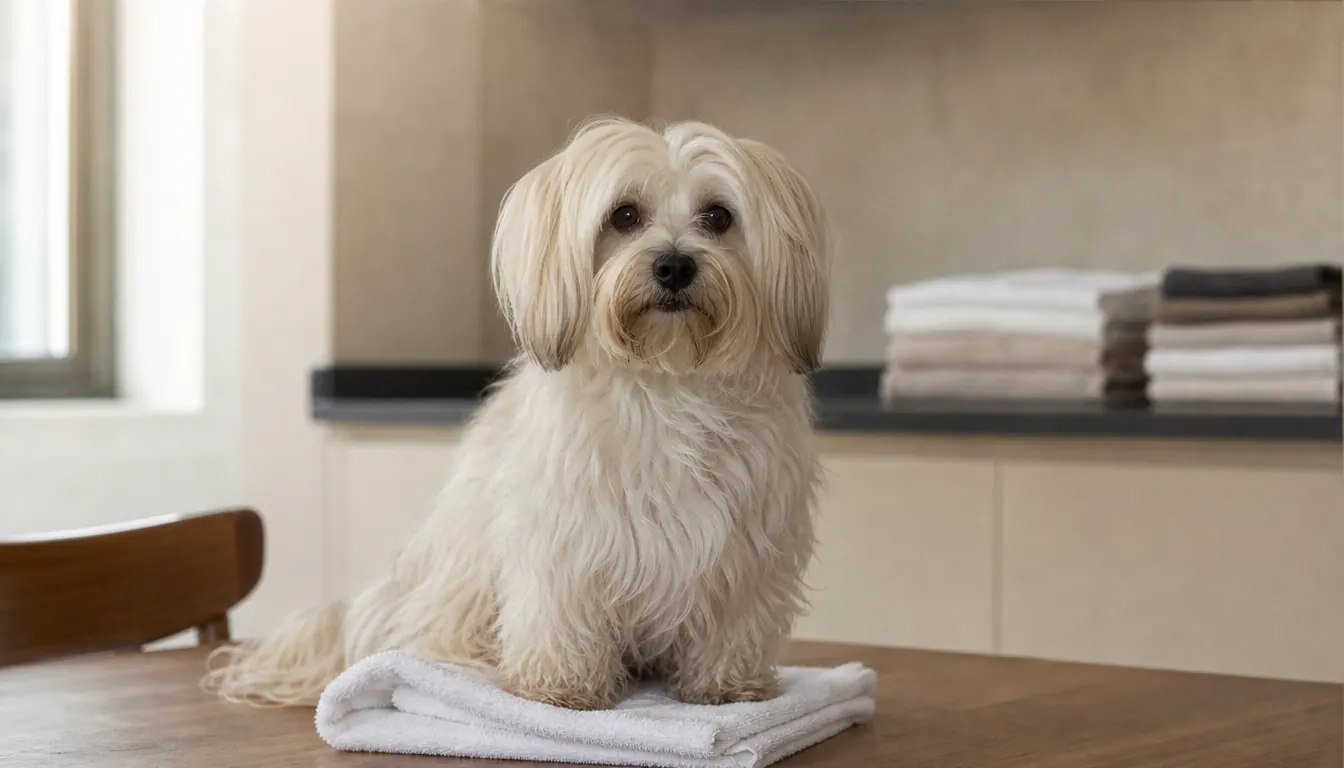
Lulu is a seven-pound Maltese with a long white coat that I keep in a puppy cut most of the year, and by the middle of February her legs and her muzzle had gone the color of weak tea. Not dirt. Something duller than dirt, the way a white shirt looks after a hundred washes. I would wash her in the kitchen sink with whatever dog shampoo happened to be on the shelf, dry her with a towel, and three days later the brightness was gone again.
A groomer twenty minutes from my house here in Roanoke told me the problem was the shampoo, not the dog. She said to stop borrowing my own shampoo and to stop reaching for a heavy oatmeal formula on a coat that is not itchy, only dingy. Then she handed me a bottle of TropiClean Whitening Dog Shampoo and told me the one thing that mattered: dilute it. That was in March. I am partway through my second 20 ounce bottle now, and Lulu has had a sink bath roughly every two and a half weeks since.
Here is the short version before the details. This is a cosmetic whitening shampoo for a dog that is already clean and just looks tired. It brightens. It does not remove tear stains, it does not cut mats, and it is not a skin treatment. If you want the honest summary, that is it. Everything below is what eight months of using it actually looked like in my kitchen.
The Quick Verdict
Brightens a dull white coat and keeps a clean scent on the dog for days, as long as you dilute it and rinse twice. It will not touch tear stains, so keep your expectations on the coat and off the face.
Amazon Check Today's Price →The bottle that brought Lulu's legs back from tea-colored to white
Awapuhi and coconut, pH balanced, paraben and dye free, 20 ounces that lasts months on a small dog when you dilute it in a cup. Rated 4.6 across more than 35,000 reviews.
Amazon Check Today's Price on Amazon →How I've Used It
I keep a plastic cup on the counter and squirt in about a tablespoon of shampoo, then fill it with warm water from the tap and stir it with my finger until it looks like thin milk. That step is not optional with this formula. Neat, straight from the bottle, it takes forever to rinse out of a coat as fine as Lulu's, and anything left behind makes her look dull again inside a day. The label brags about 5X cleaning power, and whether or not that number means much, it does lather generously, which is exactly why a small amount is enough.
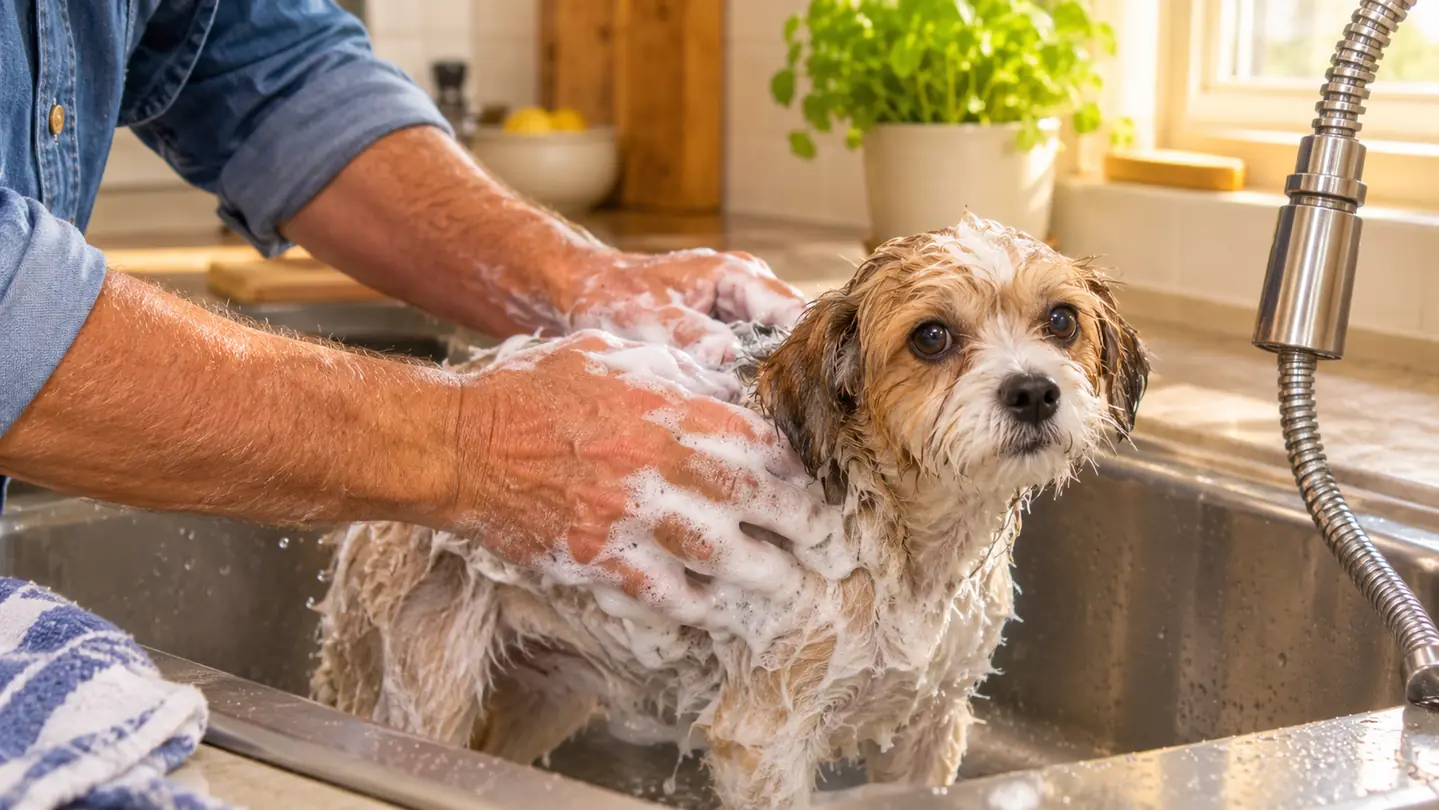
Lulu stands in the kitchen sink on a folded hand towel so her feet do not slide, and she gives me the same look of betrayal every time. I wet her down with the sprayer, pour half the cup over her back, work it in with my flat palm, then do the legs and the chest with the rest, working the lather down the back of each front leg where the dinginess collects. The suds hold up well. I am not standing there pumping more product into my hand halfway through the bath.
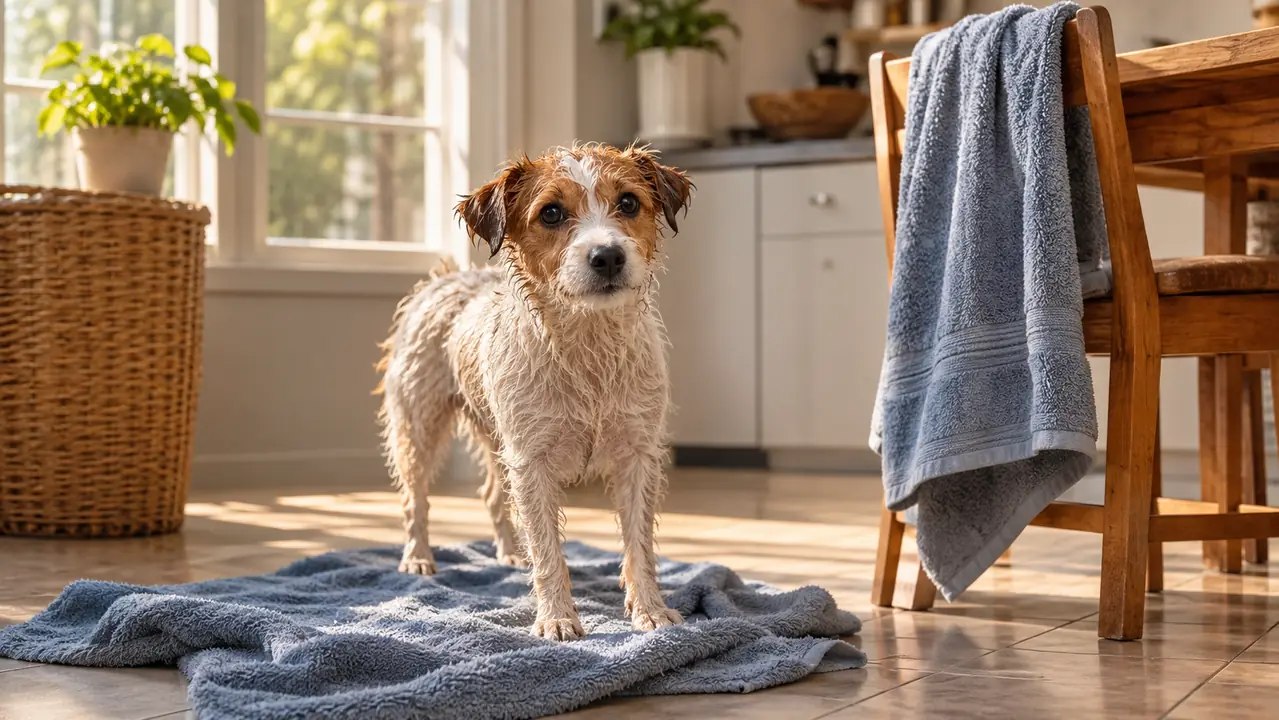
Then I rinse. Twice. This is the part that decides everything. The first rinse gets the soap out of the top of the coat, and the second rinse is the one that pulls it out from the undercoat, where a fine white coat traps it. I go over her legs and her belly a second time with the sprayer, squeeze the water out of her legs with my hand, then wrap her in a towel and set her on the folded towel on the kitchen table. Once she is dry she gets brushed. Twenty minutes, maybe twenty-five, in a sink I then wipe down and forget about until the next time.
Because she goes to a professional groomer every eight to ten weeks for a full cut, the baths in between are the only thing I control. Two to three weeks apart is the rhythm that has worked. Any closer together and I am doing laundry and washing a dog for no reason. Any further apart and the dullness comes back around the legs by the third week.
What It Actually Does to a White Coat
I noticed the change on her legs first, then around the muzzle. The tea color lifted. Not to a show-white, not to the coat of a dog in a magazine, but bright enough that I stopped noticing it, which is honestly the goal. Her coat also feels softer after a bath than it did with the oatmeal shampoo I was using before, and I put that down to the Vitamin E in the formula. It conditions while it cleans, so I have not needed a separate conditioner, which suits me because a second bottle on the sink is one more thing to knock over with my elbow.
TropiClean lists the formula as pH balanced, free of parabens and dye, and human grade. I am not a chemist and I am not going to pretend to evaluate that. What I can tell you is that Lulu has sensitive skin on her belly, the kind that goes pink if I use the wrong thing, and eight months of baths have not caused a single flare. That is worth more to me than any claim on the label.
One more thing worth saying plainly, because it took me years to understand it. Brightening shampoos work on the surface of the coat. They lift the dull, grayish cast that builds up on a white dog from saliva, dust, and the ordinary business of living in a house. They are not bleach and they are not a stain remover. A company that hints otherwise is selling you something the product cannot do, and you will find that out around bath three.
The Awapuhi Scent, and How Long It Hangs On
The scent is awapuhi and coconut. I will be honest, my first thought was that it smelled like a hotel lobby in a beach town. Tropical, a little sweet, not what I would have picked off a shelf by myself. It grew on me. By the second bath I liked it, and by the fifth I was looking forward to it the way you look forward to a clean set of sheets.
What matters more than whether I like it is how long it lasts. Days. She sleeps on the couch beside me in the evening and I can still catch it on her coat three or four days after a bath, longer than the last two shampoos I tried. It does not smell like wet dog underneath the coconut, and that alone was worth switching for. The dog smell is what gets into upholstery. The coconut is what keeps me from washing the cushion covers every month.
If you truly cannot stand sweet scents, this is not the bottle for you, and I would rather tell you now than have you find out with a wet dog in the sink. But if you have ever buried your face in a dog's neck and gotten a nose full of pond, you will understand why I keep buying it.
What It Does Not Do
I want to be straight with you about the tear stains, because this is where most white-dog owners will be disappointed and I would rather say it here. Lulu has had rust-colored staining under both eyes since she was about three. TropiClean did not lift it. Not after one bath, not after eight months of them. The staining under her eyes has faded slowly, and the reason it faded is that my groomer trims that hair out every eight to ten weeks and I wipe under her eyes every morning with an unscented wipe so the crust does not build up in the first place. The shampoo had nothing to do with it, and I would be lying if I said otherwise.
It also does not touch mats. Lulu mats behind her ears and in her armpits no matter what I do, and no shampoo on earth is going to fix that. That is a brushing job, five to ten minutes on a towel on the kitchen table most evenings with a small slicker brush, and for a tight mat it is my fingers first or the groomer's clippers on the next visit. A bottle of shampoo is not going to replace that half hour a week.
And if your dog has red skin, a rash, a hot spot, an ear that smells wrong, or eyes that are swollen rather than stained, put the bottle down and call your vet. A whitening shampoo is a cosmetic. Waiting on a cosmetic while something is actually wrong is how a small problem becomes an expensive one.
What I Liked
- Brightens a dull white coat noticeably after one bath, most obvious on the legs and the muzzle
- Conditions as it cleans with Vitamin E, so no separate conditioner is needed on a fine coat
- Awapuhi and coconut scent stays on the coat for days and covers the dog smell underneath
- Dilutes well in a cup of warm water, so a 20 ounce bottle lasts months on a small dog
- pH balanced, paraben and dye free, and gentle enough for a dog with sensitive skin on the belly
Where It Falls Short
- Does nothing for tear stains, which is the thing most white-dog owners actually want fixed
- Lathers thickly, so a careless rinse leaves a dull film and rinsing twice is not optional
- The tropical scent is strong out of the bottle and will not suit everyone
- Does not loosen or prevent mats behind the ears or in the armpits
Eight months, roughly fifteen sink baths, and the change I can point to is her legs: from the color of weak tea to white. The tear stains never budged, and I never expected them to.
The Sink Routine That Makes One Bottle Last
A 20 ounce bottle weighs 1.4 pounds and stands about nine inches tall, so it lives on the shelf above my sink without taking up the room a gallon jug would. Two of those bottles have carried me through eight months of baths every two to three weeks on a seven-pound dog. If you have a Labrador, do the arithmetic differently and expect to go through it a good deal faster.
The dilution is the whole trick, and it is why I think some of the lukewarm reviews come from people who used it neat. Straight shampoo on a small dog is a waste of product and a fight at the rinse stage. A tablespoon in a cup of warm water lathers just as well, rinses out faster, and stretches the bottle by weeks. I do not measure carefully anymore, but I measured for the first month, and I would suggest you do the same until you know what your dog's coat will take.
Between baths the rest is maintenance, and none of it is glamorous. Brushing on the towel on the kitchen table. A wipe under each eye in the morning while she waits for me to fix my breakfast. Nails ground down every two weeks so I am not listening to clicking on the hardwood all evening. All of it together is the reason a bath every three weeks is enough instead of a bath every week, and the reason the shampoo has a chance to show what it can do.
Who This Is For
This is for the owner of a white or light-coated dog who is already bathing at home and wants the coat to come out brighter than it went in. Maltese, Bichon, Havanese, a white Shih Tzu, a light Pomeranian, a toy poodle whose coat has gone grayish around the legs. It is for someone who does not mind diluting a product in a cup and rinsing twice, and who understands that a whitening shampoo is a cosmetic and not a cure for anything.
It also suits a household where the dog is on the furniture. The scent is the part my daughter notices when she walks in the door, and it is the reason I have not gone back to the plain shampoo I used for years. TropiClean earned that shelf space one bath at a time, and I am not a person who switches products for fun.
Who Should Skip It
Skip it if tear stains are your main complaint. This will not fix them, and you will be annoyed at the bottle sitting under your sink every time you open the cabinet. Skip it if your dog's coat is already bright and the only real problem is mats, because a slicker brush and a good groomer will do more for you than any shampoo on the market.
Skip it, too, if your dog has any active skin problem. Red, inflamed, itchy, crusty or smelly skin is a question for your vet, not for a brightening formula, and no shampoo is going to resolve it. And if strong tropical scents bother you, buy something plainer, because you will spend the whole bath wishing you had.
If your white dog's coat has gone the color of weak tea, this is the bottle I keep buying
Awapuhi and coconut, pH balanced, paraben and dye free. Dilute a tablespoon in a cup of warm water, lather, rinse twice, and brush once she is dry. That is the whole routine.
Amazon Check Today's Price on Amazon →