
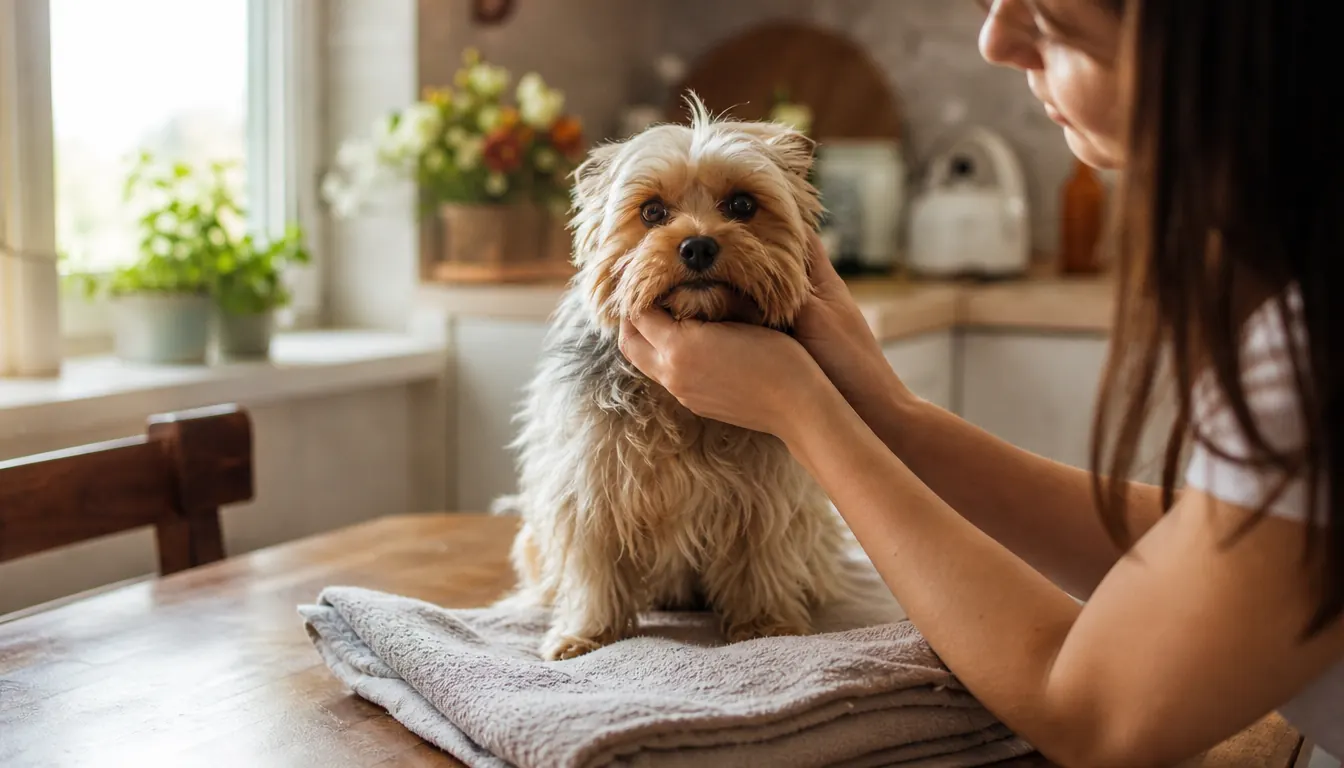
Lulu is seven pounds of Maltese and most of that is opinion. She is seven years old, she keeps a long white coat in a puppy cut most of the year, and until this spring the inside of her mouth was territory I did not enter. The coat I brushed on a folded towel on the kitchen table. The nails I did every two weeks. Under her eyes I wiped every single morning while she waited for my breakfast. Her teeth I left to the groomer every eight to ten weeks and told myself that was enough. It was not enough, and nobody had to say it unkindly.
What happened was quiet. My groomer mentioned, in a mild voice, that there was some tartar building along the back teeth. A few weeks later the veterinarian said almost the same thing at Lulu's checkup. Nothing dramatic. Just a small mouth with small, crowded teeth and a toothbrush built for a Labrador that would never fit inside it. In June I bought the Vet's Best Dog Toothpaste and Toothbrush Dental Care Kit, the 3.5 ounce tube with the triple-sided brush, and I sat down on the kitchen floor with a dog in my lap to figure it out. Five months later I know which parts of the routine worked, which parts I made harder than they needed to be, and what a toothbrush can honestly do for a dog this small.
The banana gel a fussy seven-pound dog will actually lick off the brush
Vet's Best dental kit: a 3.5 ounce tube of gel made with aloe, neem oil and baking soda, plus the triple-sided brush that fits a mouth this small. Not a treatment for gum disease. Just the nightly habit that keeps plaque from settling in.
Amazon Check Today's Price on Amazon →Step 1: Teach Her That Hands Near Her Muzzle Are Not a Trap
Lulu will not let me near her paws without a small argument, so I expected her mouth to be worse. For the first week I did not take the kit out of the drawer at all. I waited until she was already sleepy on the couch, lifted one side of her lip with a finger for about two seconds, looked at nothing in particular, and let go. Then a piece of kibble. That was the entire lesson, and I gave it seven days.
This was not my first attempt, which is worth admitting. Back in the winter I had tried wrapping a piece of gauze around my finger the way a video suggested, and Lulu treated my hand like something that had come to take her temperature. She ducked, she squirmed, she sneezed directly into my face, and after three nights I put the gauze away and decided the groomer was handling it. The difference the second time was the order: taste first, hands second, brush last. Nothing about the gauze was wrong. I had simply started at the last step and worked backwards into a fight.
The second week I held the lip a beat longer and ran a fingertip along the outside of her upper teeth, top row only, one side, then done. The third week I did both sides. She never once had to be held down, because I never asked for more than she could give in one sitting. Small dogs are not stubborn about their mouths. They are small, and everything about being handled feels enormous to them. A minute spent on this step saves a month of wrestling later.
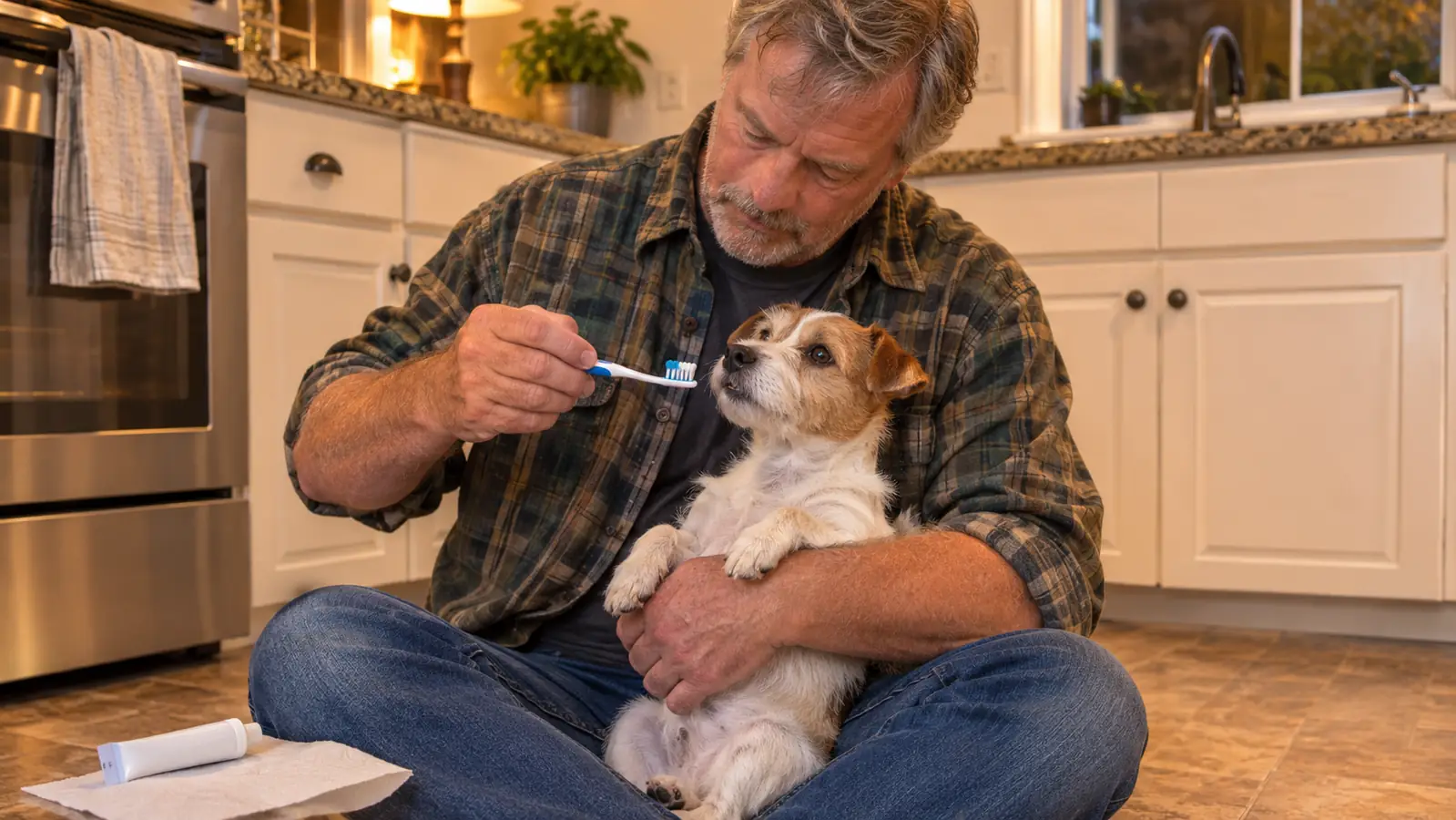
Step 2: Let Her Lick the Paste Before the Brush Ever Comes Out
The Vet's Best toothpaste is a gel, banana flavored, and that detail matters more than I expected from a dog. I squeezed a ribbon onto my fingertip and held it out. She licked it clean and looked for more, which is the first time in her life she has ever shown interest in anything to do with her mouth. We did that most nights for two weeks with no brush in sight.
Only after she was reliably interested did I put a little of the gel on the brush and let her chew at it on her own terms. No scrubbing. Just the taste and the feel of bristles. This is the step people skip, and it is usually why brushing turns into a fight by week two. If the paste is a treat first, the brush is not a stranger when it finally shows up.
Step 3: Brush the Outside Surfaces, in Small Sections, Back to Front
You are not brushing the inside of the teeth, the side that faces the tongue. You can try, and on a seven-pound dog with a mouth the size of a walnut you will lose the argument and possibly the habit. The outside surfaces, the ones that touch the lip, are where plaque shows up first and where a brush can actually reach. That is the whole job.
The triple-sided brush is why this takes a minute instead of five. The bristles are set on more than one side, so a single pass along the gumline cleans several surfaces at once, which means fewer passes and less time holding a squirmy dog still. I work in four sections: upper right, upper left, lower right, lower left. A few small circles in each, then a second slower pass along the gumline where the tooth meets the lip.
Her back molars are the hard part. A seven-pound mouth is short, and the back teeth sit well behind the corner of the lip, so I draw the lip gently aside with my thumb and work the brush in at a slight angle rather than trying to push it straight back. Two or three small circles a side is about what she will tolerate before a paw comes up in protest, and two or three circles done nightly beats a complete scrub once a week. The little front teeth behind the lower lip take about five seconds.
Angle the brush so the bristles touch the gumline, not just the flat of the tooth. Be gentle. If the bristles are bending hard against the tooth, you are pressing too much. A little pink on the brush the first week or two is not unusual if the gums have been neglected. Bleeding every single time you brush is a call to the veterinarian, not a reason to press harder.
At her September checkup the veterinarian looked in Lulu's mouth, nodded, and asked what I had changed. The answer was one minute a night, a banana-flavored gel, and a brush small enough to fit.
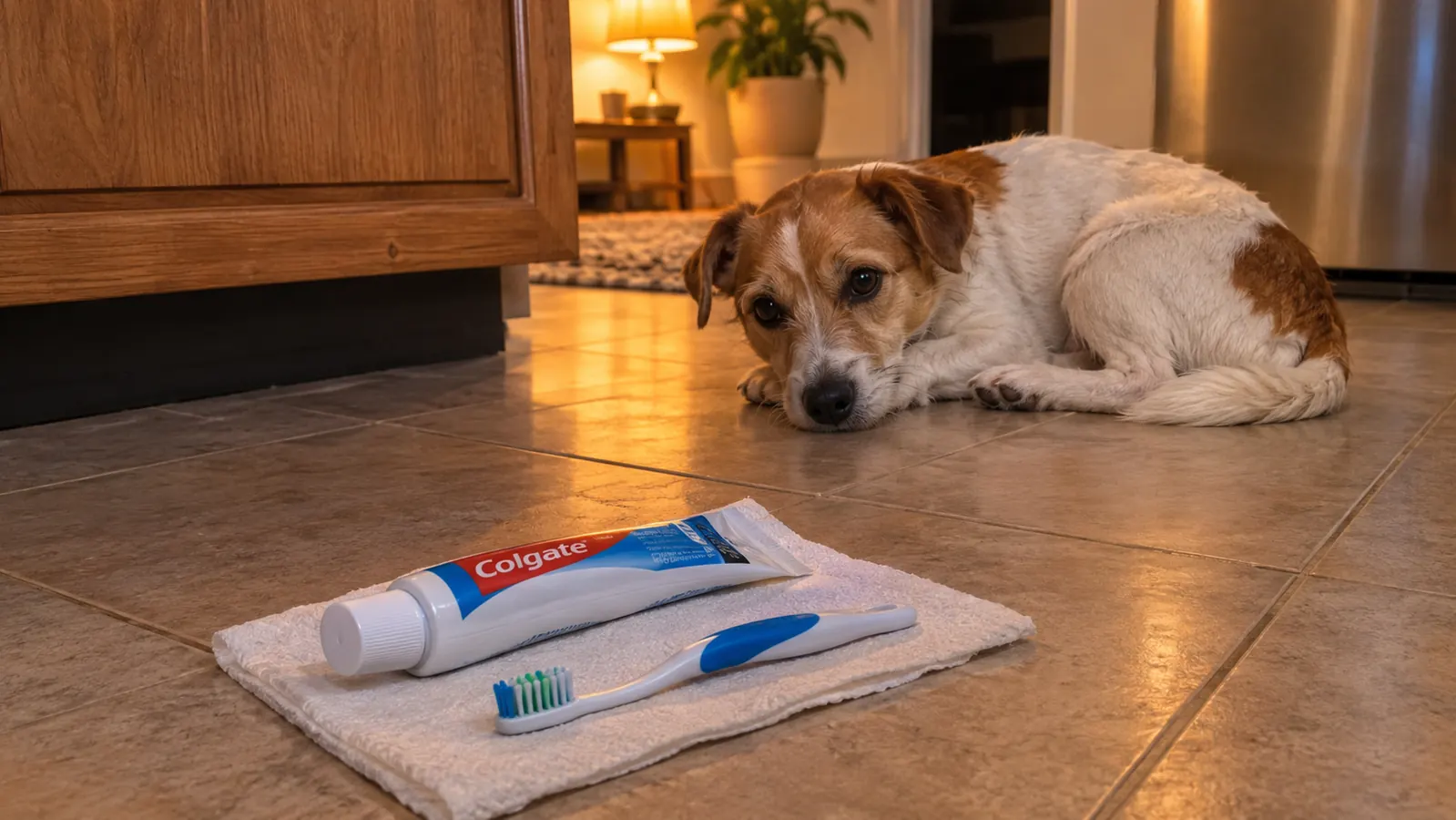
Step 4: Make It One Minute, After Supper, on the Kitchen Floor
Our routine is not fancy. After we both eat, I sit on the kitchen floor with my back against the cabinet, Lulu in my lap facing away from me, the tube and brush on a folded paper towel beside my hip. About a minute, maybe seventy seconds. I do not chase perfection, and I do not try to reach every tooth on both sides every single night.
Timing is the whole trick. Same time, same place, same order, because she is already in my lap after supper and already expecting the evening to go a certain way. Dogs build habits faster than people do, and they build them on sequence. Once the floor, the towel and the tube mean the same thing every night, most of the resistance goes out of it.
One night in July I tried to do the whole mouth standing up, because my back hurt from the floor, and it went badly. She backed away, I followed her, she turned her head into my sweater, and I got maybe two teeth done before I gave up and put the tube away. Sitting down matters more than I would have guessed. On the floor she is over my lap and settled and there is nowhere for either of us to go. I keep an old cushion by the cabinet now, and I do not bother with the standing version.
The other thing I do is stop while it is still pleasant. If I push for one more section and she starts to pull her head away, the next night is harder and I have traded a good habit for a small win. Better to end on a good note with a piece of kibble than to insist on the last two teeth. She comes back willingly the next night, and that is worth more than the two teeth.
Step 5: Hold the Schedule and Know What a Toothbrush Cannot Do
Most nights is the goal. Some weeks it is four nights out of seven and the house does not fall down. Two nights missed in a row is not a crisis. Three weeks off is how people end up back where they started, with a groomer making a mild comment and a dog who has forgotten the whole routine.
Here is the honest limit, and I say it as someone who likes the product. A toothbrush and dog toothpaste clean plaque off the surface of the teeth. They do not dissolve tartar that has already hardened onto the tooth, they do not treat gum disease, and they do not replace a professional cleaning under anesthesia when your veterinarian says one is due. The Vet's Best kit is not a medical treatment. It is the thing that keeps the daily surface clean between the visits that genuinely require a veterinarian.
Also, and this one matters: never use human toothpaste on a dog. And if you see red, swollen gums, a smell that does not improve after a couple of weeks of brushing, a loose tooth, or a broken tooth, that is a vet visit, not a toothpaste problem. Brushing on top of an untreated sore mouth just makes a sore mouth sorer.
What Else Helps
Brushing is one habit in a small dog's week, not the whole of it. Fresh water available all day, something safe to chew that gives the teeth some work to do, and a dental chew if your veterinarian is fine with the calories. None of those replace the brush. They just mean the brush has less to catch up on.
Water is the piece people overlook, and I was one of them. Lulu will not drink from a bowl that has been sitting out since morning, so I rinse it and refill it with fresh water every day, and I can tell the difference in her breath on the weeks I forget. She also gets a dental chew most afternoons, which is not a substitute for the brush but does give her teeth something to work against, and I asked before adding it because a seven-pound dog fills up fast and the wrong chew is a choking risk for a mouth that small.
It also helps to build the rest of the routine around the same few minutes so you are not remembering five separate chores. My mornings are the eye wipes while Lulu waits for my breakfast. Every two to three weeks she gets a bath in the kitchen sink, which keeps her coat bright and keeps her smelling clean on the couch. Evenings are the towel on the kitchen table for the coat, and after supper it is the minute on the floor with the brush.
Keep the brush where you will see it. Mine lives in the kitchen drawer with the dish towels, next to the tube, which sounds trivial until you realize that a kit in a cupboard upstairs is a kit that gets used twice. And if your dog's mouth is a genuine mess right now, with heavy tartar and gums that bleed at a touch, start with the veterinarian, get the cleaning done, and then start the brushing habit on a clean mouth. That order matters more than any technique in this article.
Start with the tube and the small brush, and give it two weeks before you judge it
Vet's Best dental kit: 3.5 ounces of banana gel with aloe, neem oil and baking soda, plus the triple-sided brush. Let your dog lick the paste first. Keep the sessions short enough that she comes back for the next one.
Amazon Check Today's Price on Amazon →