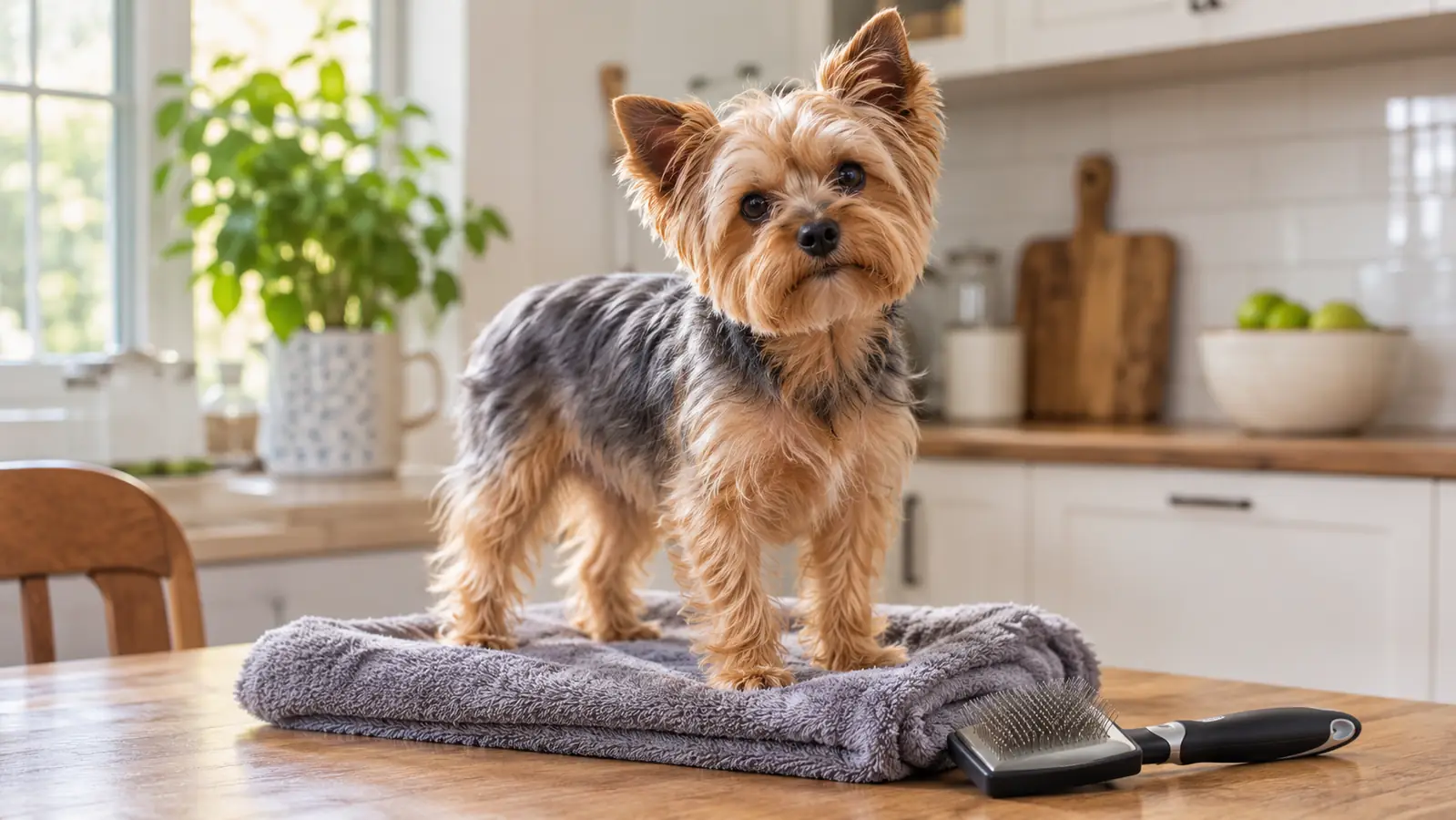
Short answer: for a Maltese in a puppy cut, the Coastal Pet Li'l Pals slicker brush is the better daily brush. I have a 7-year-old Maltese named Lulu, about 7 pounds, and her coat stays in a shorter cut most of the year. Our grooming happens on a folded bath towel on the kitchen table, most evenings, for five to ten minutes. The Coastal is the brush I reach for. A pin brush has its place, and I will get to that, but it is not the first tool I would buy for a small dog who mats behind the ears and under the front legs. If your dog wears a long coat and you line brush every day, the answer may flip. For my dog, on my table, the slicker wins the daily job.
I bought the Coastal last fall, about a year ago, after our groomer showed me the mats behind Lulu's ears. The brush is one size, 3.25 by 7.25 inches, with flexible wire pins and plastic-coated tips. The handle is plastic. It lives in the kitchen drawer by the dish towels, which tells you how often it gets used. It loosens tangles and pulls loose hair from the topcoat. It does not cut or remove a tight mat by itself. I still work a stubborn mat apart with my fingers first, or I leave it for the groomer. That is not a flaw in the brush. It is what a slicker brush is for, and it is why I keep a pin brush comparison honest.
| Coastal Li'l Pals slicker | Standard pin brush | |
|---|---|---|
| Best coat length | Short to medium puppy cuts and the finish work on a longer coat | Long, flowing coats that need line brushing |
| Daily once-over on a small dog | Small head reaches behind the ears, armpits and backs of the legs | Larger head covers more coat in fewer strokes |
| Face, paws and tight spots | The 3.25 by 7.25 inch head and flexible pins work around small areas | Longer pins and wider spacing are awkward near the eyes and paws |
| Loose hair and surface tangles | Wire pins pull loose hair and smooth the topcoat | Pins separate the coat and fluff it up |
| Tight mats | Does not cut or remove a tight mat; work it apart with fingers or see the groomer | Does not cut mats either; a mat rake or groomer is the answer |
| Comfort on sensitive skin | Plastic-coated tips on each pin | Many pin brushes have bare pin ends, so check yours |
| Control in one hand | Light plastic handle and a small rectangular head | Often a heavier handle and a larger head |
| Cleaning between uses | Loose hair lifts from the coated pins | Wider spacing sheds hair quickly |
| Best for | Daily upkeep between groomer visits on a small coat | A long show coat or a dog that tolerates line brushing |
Where Li'l Pals Wins
The first thing the Coastal has going for it is size. Lulu is seven pounds. A pin brush with a wide head and long pins feels like a rake in my hand on her back. The Coastal head is 3.25 by 7.25 inches, small enough that I can work in sections instead of dragging a big brush over her whole side. That matters behind the ears, where the coat is fine and tangles form in a knot the size of a pea. I part the hair with my fingers, then use the slicker in short strokes. The flexible wire pins follow the shape of her body instead of scraping across it. I can feel the tangle give way without pressing hard. On a dog this small, a brush that fits the dog is not a small detail. It is the whole job.
The second advantage is the coated tips. Lulu is fussy about her ears and her paws. She will tolerate a brush that does not scratch. The plastic tips on each pin are the reason I can use the Coastal on the backs of her legs without her pulling away. It also picks up the loose white hair that would otherwise end up on the couch. I brush her on the towel, and the hair stays on the brush and the towel instead of floating across the kitchen. For a small dog in a puppy cut, that is most of the work. The Coastal is not a mat cutter and it is not a finishing brush for a show coat. It is a daily maintenance tool, and it does that job well.
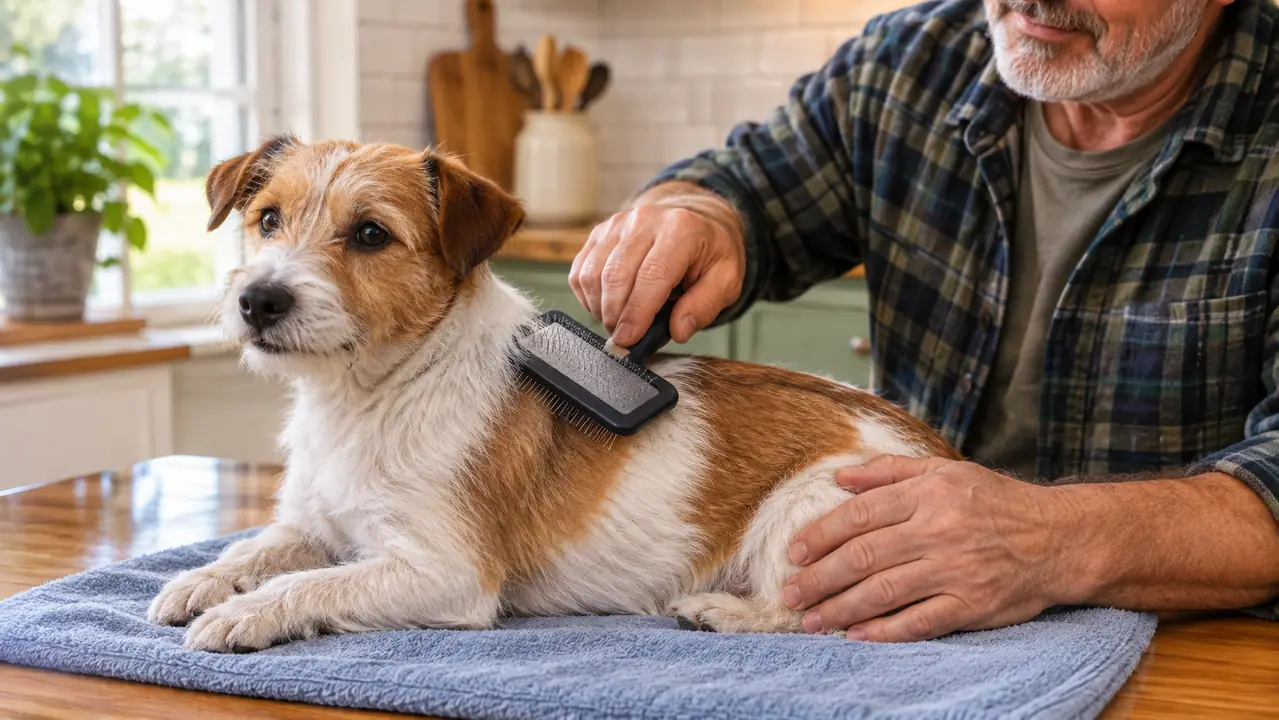
Here is how it actually goes on a Tuesday evening at my house. I lay the towel out, set Lulu on it facing me so she cannot see the drawer open, and start on her left side. Three or four short strokes behind the ear, then I lift the brush and look at it. If there is a little nest of white hair in the pins, good, that is hair that is not on the couch. If the pins come away empty and the coat still feels rough under my fingers, there is a tangle I have not gotten to yet, and I go back in with my free hand to find it before I use the brush again. It takes a few evenings to learn where her coat hides things. Behind the ears first, always. Then the armpit, where the skin is thin and she will flinch if I come at it flat. Then the backs of the back legs, which pick up a surprising amount from the rug and the yard. Once I found the order, the five minutes actually became five minutes instead of fifteen.
A third advantage is that the Coastal is easy to keep clean. The pins are close enough to catch hair and open enough that I can pull the hair out with my fingers after each session. I do not have to dig at the base of every pin with a comb, which is what the old brush in my bathroom drawer required. I keep the Coastal in the kitchen drawer, and I do not want a brush that needs a shelf of tools to maintain it. This one gets a quick clean, goes back in the drawer, and is ready the next evening. That matters when you are brushing a small dog five nights a week. The tool you actually reach for is the one that stays clean and close at hand.
I should be honest about what I tried before this. My first brush for Lulu was a soft bristle brush, the kind that looks like a hairbrush, because it seemed gentle. It was gentle, all right. It went over the top of the coat and did nothing underneath, and by the time I noticed, she had a mat behind her left ear the size of my thumbnail that I could not budge. That is the mat the groomer pointed at, and that is the evening I came home and ordered the Coastal. The lesson was not that soft brushes are bad. It was that a brush has to reach the coat that is actually there, not just the surface of it. The Coastal's wire pins get under the top layer. The bristle brush never did.
The Coastal is not a mat cutter. It is the brush that keeps a small coat from becoming a mat in the first place.
Where a Pin Brush Wins
A pin brush wins on length. The pins are longer and set wider apart, so they can pass through a long coat and separate the layers. If Lulu were in a full, floor-length Maltese coat, I would want a pin brush for line brushing, working through one thin section at a time from the skin out. The long pins reach deeper than the short wire pins on the Coastal. They also fluff the coat after a bath. A pin brush is the tool that makes a long coat look airy instead of flattened. That is a real job, and the Coastal cannot do it as well. If you are growing out a show coat, the pin brush is not a luxury. It is the main tool.
A pin brush also wins on coverage. The head is usually larger, and the wider spacing means it covers more coat in fewer strokes. On a dog that stands still and tolerates a long grooming session, that is faster. It is also easier to clear hair from a pin brush between strokes because the pins are farther apart. The trade-off is that longer, wider pins are clumsy around the face and paws. If the pins have bare ends, they can scratch a sensitive dog. I would not use a pin brush on Lulu's armpits or the backs of her legs. I would use it on her back and sides if her coat were long.
My neighbor Denise has a Havanese in a full coat, and I have watched her work with a pin brush on her back porch. She does it in sections about an inch wide, lifting the hair with one hand and brushing from the skin outward with the other, and it takes her the better part of half an hour. Watching that changed how I think about the two brushes. She is not brushing the coat. She is separating it, layer by layer, so the air gets in and the hair does not lie down on itself and mat. The Coastal cannot do that on a coat that long, because the pins are short. But Denise keeps a small slicker in her kit too, and she uses it on the Havanese's face and feet, exactly the spots where the pin brush is too clumsy. Two brushes, two jobs, and she would not give up either one.
One more point for the pin brush: it is better at lifting a coat that has been flattened by a harness or a nap on the couch. A few passes with a pin brush can make a long coat look fuller. A slicker brush smooths the surface, but it does not separate the layers the same way. If you have a Maltese in a long coat and you want that soft, rounded look, the pin brush does more of that work. The Coastal is still useful for the face, the paws and the spots where mats start. The two brushes are not enemies. They do different jobs, and a long-coated dog may need both.
The brush I keep by the dish towels for Lulu's daily once-over
The Coastal Li'l Pals slicker has a 3.25 by 7.25 inch head, flexible wire pins and plastic-coated tips. It is the brush I use on the kitchen table most evenings for five to ten minutes, especially behind the ears and under the front legs.
Amazon See the Coastal Li'l Pals Brush on Amazon →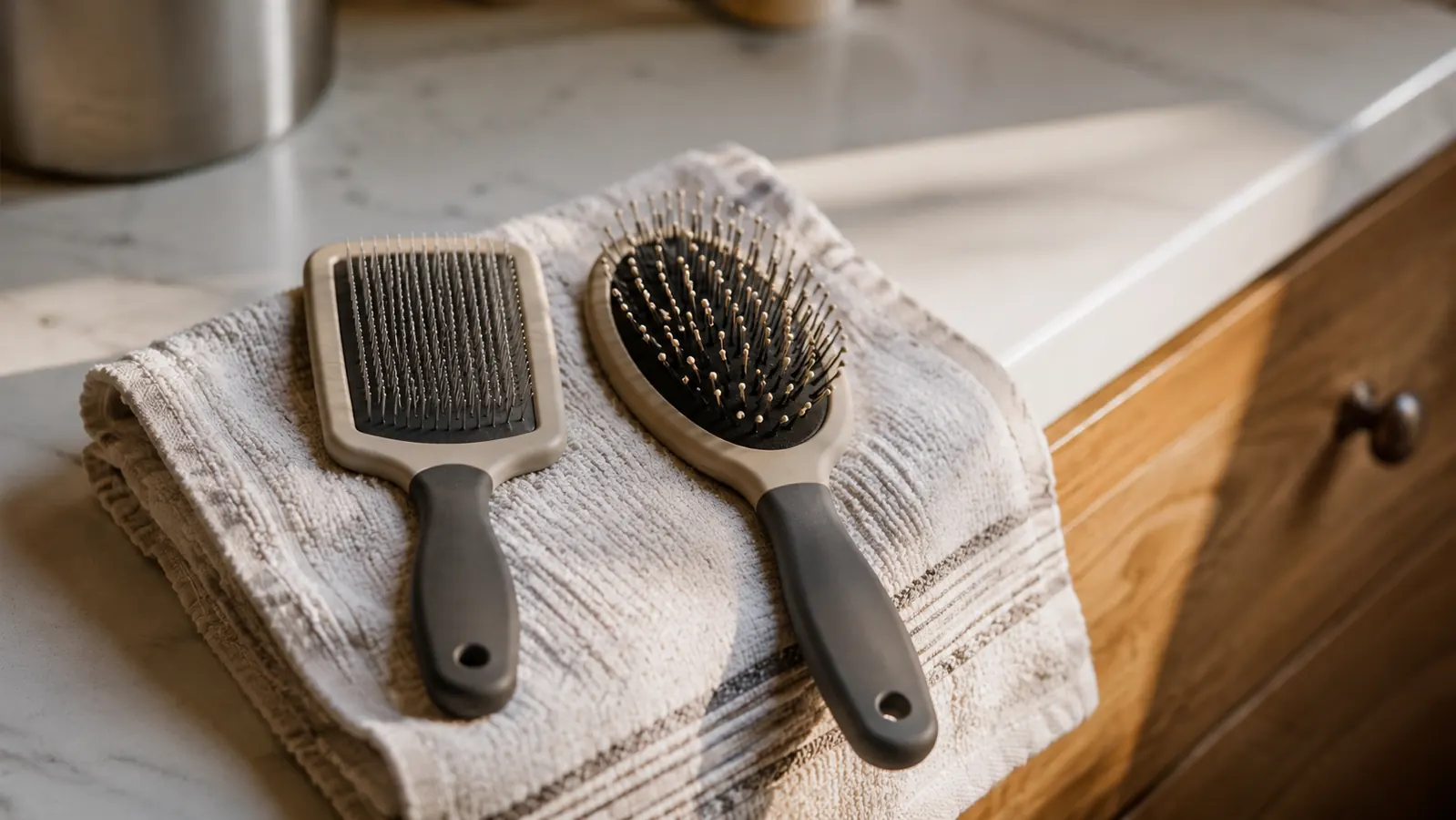
Who Should Buy Which
Buy the Coastal Li'l Pals slicker if you have a small dog in a puppy cut, a short summer clip, or a coat you maintain between groomer visits. It is the right brush for a five-minute once-over on the kitchen table, especially behind the ears, in the armpits and on the backs of the legs. It is also the better choice if your dog is fussy about being brushed. The coated tips and small head make it easier to work without a fight. If your dog is seven to twelve pounds and wears a practical trim, this is the brush that will earn its place in the drawer.
Buy a pin brush if your dog is in a long coat and you are willing to line brush. A pin brush is the tool for a full Maltese coat, a show trim, or a dog that stands calmly for a longer session. It is also the better tool after a bath when you want to lift and fluff the coat. If you already have a pin brush and a long-coated dog, keep it. Add the Coastal for the face, paws and daily tidy-up. The pin brush does the heavy lifting on length. The Coastal does the detail work on the small spots that mat first.
For Lulu, I use the Coastal most days. She is in a puppy cut, and her coat mats behind the ears and under her front legs. The slicker is small enough to get into those spots and gentle enough that she does not pull away. I still use my fingers first on a tight mat. If the mat is set hard against the skin, I stop and let the groomer handle it. A brush is not a substitute for a groomer, and it is not a medical tool. If Lulu's skin looks red, irritated or infected, I call the vet. I do not try to brush a skin problem away. That is the line I do not cross.
If you are choosing one brush and your Maltese wears a puppy cut, choose the Coastal. If your Maltese wears a long coat and you groom it at home, choose a pin brush first and add the Coastal for detail work. That is the honest split. The Coastal is not the only brush I would own if I had a long-coated dog, but for my seven-pound Lulu and her short coat, it is the one that earns its place in the kitchen drawer. It is also the one I would hand to a friend with a Shih Tzu or a Yorkie in a practical trim.
What I would not do is buy a big pin brush for a small dog in a short coat and expect it to solve mats behind the ears. The long pins are too much for those tight spots. I would also not expect the Coastal to break up a mat that has already set. No slicker brush does that. You need fingers, a comb or a groomer for a hard mat. The right tool for daily upkeep is the one that fits the coat you actually have, not the coat you see in a show ring.
A small brush for the small spots that mat first
The Coastal Li'l Pals slicker is 3.25 by 7.25 inches with flexible wire pins and plastic-coated tips. It is the brush I use on Lulu's ears, armpits and the backs of her legs, and it lives in the kitchen drawer by the dish towels.
Amazon Check the Coastal Li'l Pals Brush on Amazon →