The mats behind Lulu's ears did not appear overnight, but the morning I found them it felt that way. She is a seven-year-old Maltese, about seven pounds, and I keep her in a puppy cut most of the year because a full show coat is more work than either of us wants to take on. I had her on the folded towel on the kitchen table, parting the hair behind her left ear the way I do most evenings, and my fingers found a knot the size of a pea that would not move. I had a pin brush in the drawer and a comb beside it, and both of them did nothing but skate over the top of it. That is where this review honestly starts. Not with a product I went hunting for because I enjoy grooming gadgets. With a knot, a fussy little dog, and a drawer of brushes that were not up to the job.
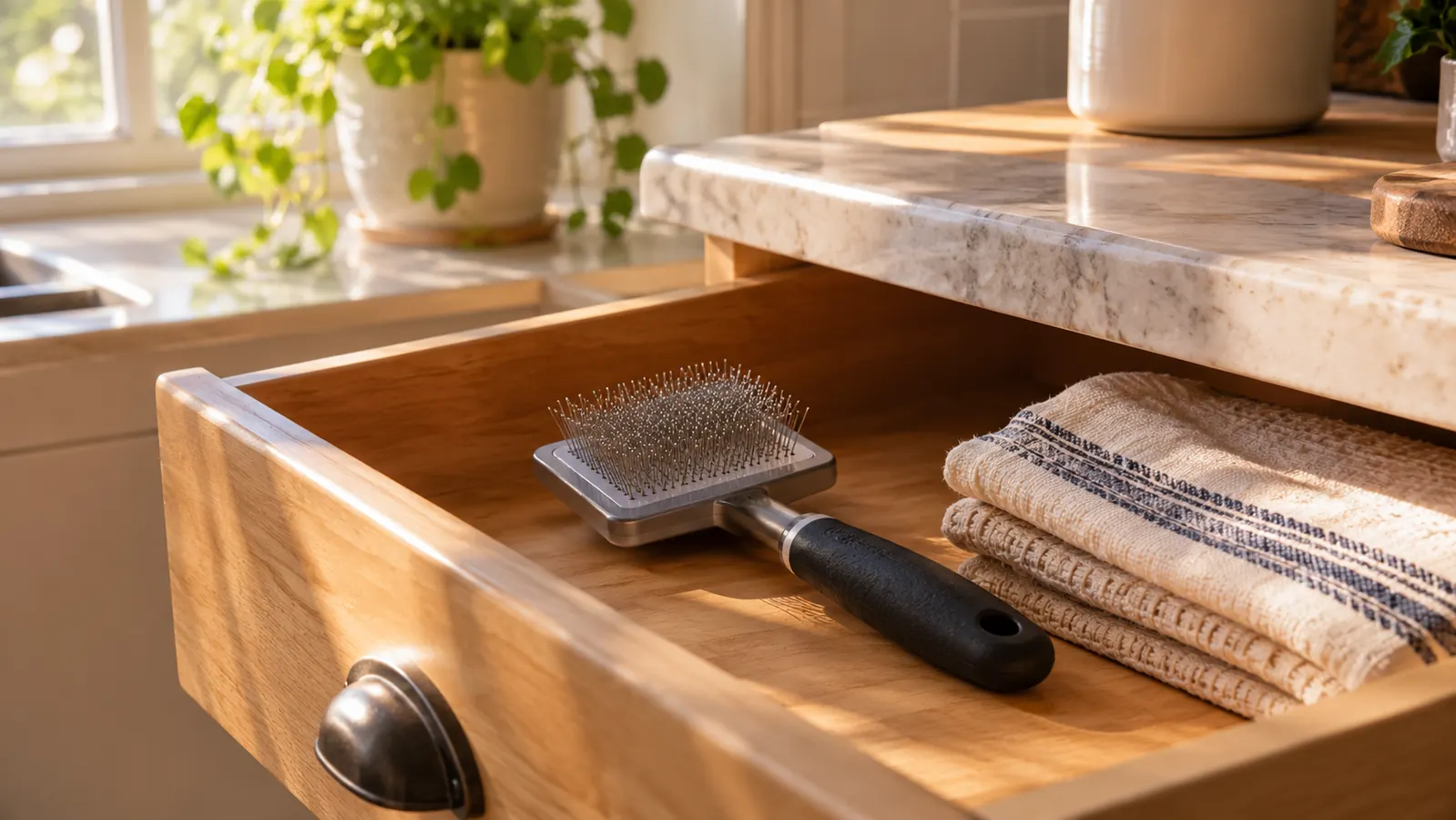
A groomer over in Roanoke showed me what she reaches for on the small dogs that come through her shop, and it was the Coastal Pet Li'l Pals slicker brush. I bought one last fall, about a year before I am writing this, and it lives in the kitchen drawer by the dish towels now. Most evenings I use it for five to ten minutes. I have also used it wrong, and it took me a few months to understand the difference between the two. That is the part nobody mentions. So this is an honest review, not a love letter. What the brush does, what it does not do, and the things I had to learn by making small mistakes on a dog who forgives me.
The Quick Verdict
A light little slicker that gets under tangles on a seven-pound coat without scraping skin. It loosens knots and lifts loose hair. It will not cut a mat out for you, and it does not replace your groomer.
Amazon Check Today's Price →The brush that finally got behind Lulu's ears
Small head, flexible wire pins with plastic tips, and a plastic handle that fits a two-finger grip. It has been sitting in my kitchen drawer for a year.
Amazon Check Today's Price on Amazon →What It Actually Is, in Plain Terms
It is a slicker brush and nothing fancier. The head is rectangular, 3.25 inches by 7.25 inches, and the whole thing weighs 0.96 ounces. The pins are wire, set into a flexible pad so the surface gives a little when you press it against a dog, and every pin has a plastic tip on the end. The handle is plastic. There is no button, no retracting mechanism, nothing to adjust, and nothing to lose. You pick it up and you brush. For someone who has spent an evening reading grooming listings online, that simplicity is either the appeal or the disappointment, depending on what you were hoping to find. Coastal sells it as a one-size slicker for small breeds and puppies, and that is exactly what it is.
The size is the whole point. A standard slicker built for a forty-pound dog is wider than Lulu's entire ear flap, so you end up working the flat of the pad against skin you cannot see. This one is small enough that I can hold the hair back with two fingers of my left hand and work the brush into the gap with my right. That is the reason the groomer handed it to me. Not because it is better made than a large brush, but because it fits a small dog.
The weight matters more than I expected. 0.96 ounces does not sound like a number worth writing down until you have held a brush in the air for ten minutes over a wriggling dog while your other hand holds a section of coat apart. A heavier brush tires my wrist out by the time I reach the backs of the legs. This one does not. It is a small thing that turns into a large thing around the fourth evening in a row.
How I've Used It on Lulu
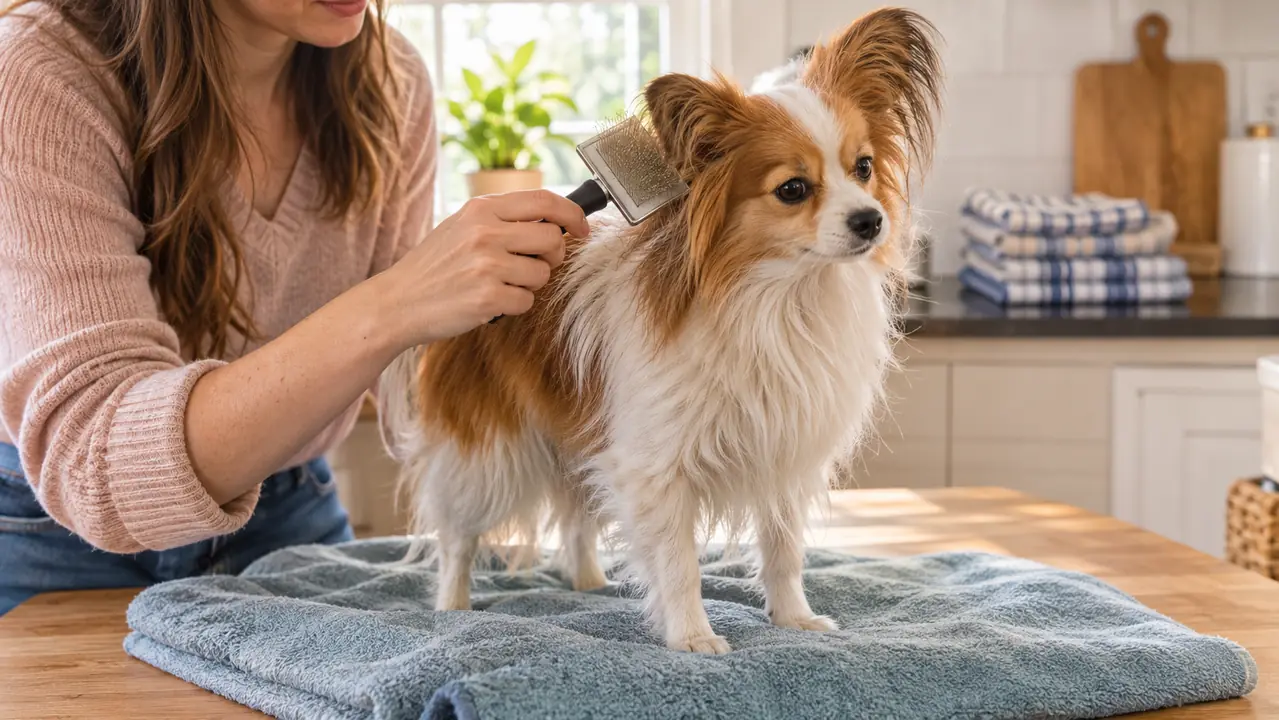
The setup has not changed in a year. A folded bath towel on the kitchen table, Lulu standing on it, me standing at the corner so she cannot see the floor and decide to leave. I go in the same order every time: behind the right ear, behind the left ear, under the front legs, then down the backs of the back legs where the coat rubs against itself. Five to ten minutes, most evenings, sometimes less if she is tired and leaning into my arm.
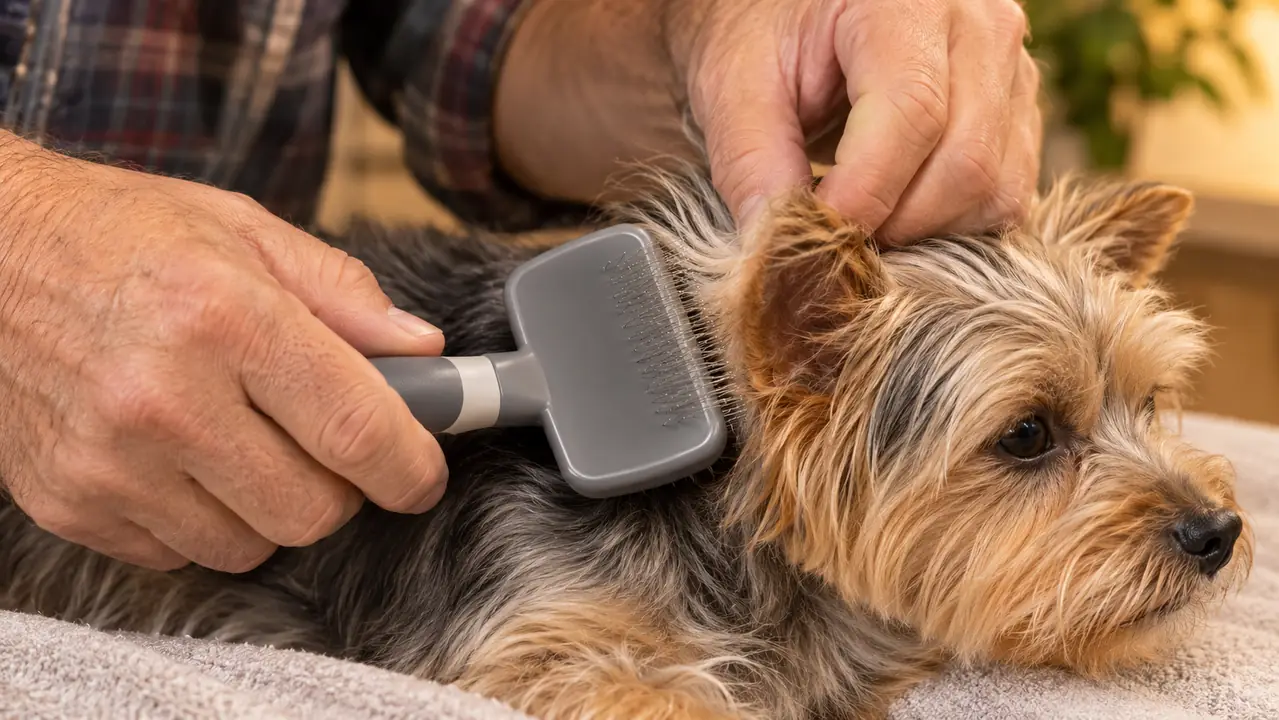
The technique is the part that makes this brush work, and I did not have it at first. You hold the hair at the root with two fingers, right down where it meets the skin, so the pins are not dragging against the skin itself. Then short strokes, an inch or two at a time, starting at the end of the tangle and working back toward the body. When I started, I did long strokes outward from the skin, and that is how you turn a small knot into a tighter one. Lulu told me so by stepping off the towel and walking to the door.
What she tolerates is quite a lot, as long as I stop when she lifts a front paw. She does not love the armpits. She will allow a few strokes, then she turns her head and looks at me, and I take that as the end of that section and come back to it the next night. Over a week the armpit gets done. Over one sitting it does not, and pushing through just teaches her to dread the sight of the towel.
What It Does Well
It loosens tangles. That is the plainest and most accurate thing I can say about it. The pins get underneath the knot instead of riding over the top, and the knot starts to separate into smaller pieces I can work apart with my fingers. The plastic tips matter here. A slicker with bare wire ends will leave pink scratch marks on thin skin. This one has not, in a year of near-daily use, and the listing claim about the tips not irritating sensitive skin has held up on my one dog.
It pulls loose hair. When I finish a section I look at the pad and there is a small grey mat of hair sitting in it, and I lift it out in one piece and drop it in the wastebasket beside the table. That is hair that would otherwise be on the couch, in my bed, or in the corners of the kitchen floor. For a seven-pound dog she produces a surprising amount of it, and the brush catches what a pin brush only lifts into the air.
The listing also says it helps stimulate and distribute the coat's natural oils. I cannot measure that and I am not going to pretend I can. What I can tell you is that her coat looks smoother across the back after a week of regular brushing than it does after a week of skipping it. Whether that is the oils or simply the fact that the hair is lying flat and untangled, I could not say, and I would not trust anyone who told me they could.
The knot behind her left ear came apart in about two minutes. The one tucked into her armpit took me three evenings, and then I let the groomer have it.
What Nobody Tells You About a Slicker Brush
The first thing is that a slicker brush does not remove a mat. It loosens, separates, and lifts. A tight mat, the kind that is felted against the skin like a little piece of wool, is not something this brush fixes. I have read enough listings to know the word detangling gets used loosely. Here is the honest version: on a loose tangle, this brush does most of the work in under a minute. On a tight mat, you work it apart with your fingers first, in small pieces, and if it is not coming apart you stop and let the groomer deal with it. Pulling a felted mat with any brush hurts, and a dog remembers being hurt.
The second thing is that pressure is the wrong instinct. When a knot resists, the hand wants to push harder. That is exactly backwards. Hard pressure drives the pins into the skin while the knot stays where it is. Light strokes at the end of the tangle, working inward, do more in thirty seconds than a firm hand does in five minutes. It took me a couple of months to stop bracing my wrist and leaning on it.
The third thing is that the pad needs cleaning, and nobody mentions it. Hair packs down into the base of the pins. Once a week or so I sit at the table and pull the felted hair out of the pad with my fingers, and every so often I run a comb through the pins from the base outward. A brush with a packed pad does not grab anything, it just glides. If you have been using yours for a year and it has stopped working, look at the pad before you blame the brush.
The fourth thing is that it does not replace your groomer. Lulu still goes every eight to ten weeks for a full cut. What the brush does is stretch that appointment out and turn it into a cut instead of a rescue. Before I had it, the groomer would spend the first ten minutes of the visit working knots out from behind the ears, and I could tell from her face that it was not a good use of anyone's time or of Lulu's patience.
Where It Falls Short
The handle is small, and that cuts both ways. It suits me fine. If you have arthritis in your hands or a weaker grip, a thin plastic handle is not the most comfortable thing to hold for ten minutes at a stretch, and I would rather say so than pretend otherwise. It is a brush built for a small job and a small hand.
The hair has to be pulled out by hand. There is no push button that clears the pad for you the way some brushes have, so you pick the hair out with your fingers. It takes about thirty seconds and it is not difficult, but it is not nothing either, and on a dog who sheds steadily you will be doing it every single time you brush.
It still does not solve the armpits on its own. Lulu flinches there no matter what I use, and the brush only helps once she is calm enough to let me hold the hair apart. That is a dog problem rather than a brush problem, and I am not going to sit here and tell you a grooming tool fixed it.
What I Liked
- Small 3.25 by 7.25 inch head reaches behind the ears and into the armpits on a seven-pound dog
- Plastic-coated pin tips have not scratched or pinked Lulu's skin in a year of near-daily use
- At 0.96 ounces it does not tire your wrist during a ten-minute session
- Lifts loose hair out of the coat instead of pushing it into the air
Where It Falls Short
- Loosens tangles but will not break up a tight, felted mat
- Hair has to be pulled out of the pad by hand, there is no self-cleaning mechanism
- Thin plastic handle is not kind to hands with a weak grip
- Stretches time between groomer visits, it does not replace them
One Year In: How the Brush Has Held Up
A year of near-daily use has not changed the brush much. The pins are still straight. The pad has not cracked or pulled away from the head. The plastic handle has no split in it, and there is no rust anywhere, which I half expected given that it lives three feet from a kitchen sink. I clean the pad every week or so and I have never had to set it aside to dry or treat it gently. It gets dropped in a drawer and forgotten until the next evening.
The only wear item is the hair itself. That sounds like a joke, but it is the honest answer. Hair packs into the base of the pins, and if you let it build up for a month the Coastal brush stops grabbing and you will convince yourself it has worn out. It has not. Pull the pad clean and it works like it did the first week. That is the difference between a small tool that lasts a year and one that gets thrown out in March.
Who This Is For
If you have a small dog with a coat that tangles, and you are doing the in-between work yourself on a towel on the kitchen table, this is the brush I would hand you. It fits the awkward places. It has not scratched my dog. It has lasted a year with the pins still straight. If your dog is a Maltese, a Shih Tzu, a Yorkie, a Havanese, a Bichon, or a toy poodle in a shorter trim, the size is right and the pins are gentle enough to use daily.
It is also a sensible first slicker for someone who has been brushing with a pin brush and wondering why the knots behind the ears keep coming back. A pin brush smooths the top of the coat. A slicker gets underneath it. That is the difference, and it is a bigger difference than the photographs online make it look.
Who Should Skip It
Skip it if your dog's coat is genuinely matted. Mats that are tight against the skin need a groomer, or a proper dematting tool used by someone who knows how to use it without hurting the dog. A small slicker worked into a felted mat is a bad twenty minutes for both of you, and it will not finish the job.
Skip it if you have a large dog with a heavy double coat, because there is a right size of slicker for that job and this is not it. Skip it too if you want a brush that cleans itself at the push of a button. This one does not, and you will find that out on day one.
One small brush, one drawer, one year of evenings
If the knots behind your dog's ears have gotten ahead of you, this is the tool that got me back on top of them. It earns its place in the kitchen drawer.
Amazon Check Today's Price on Amazon →